


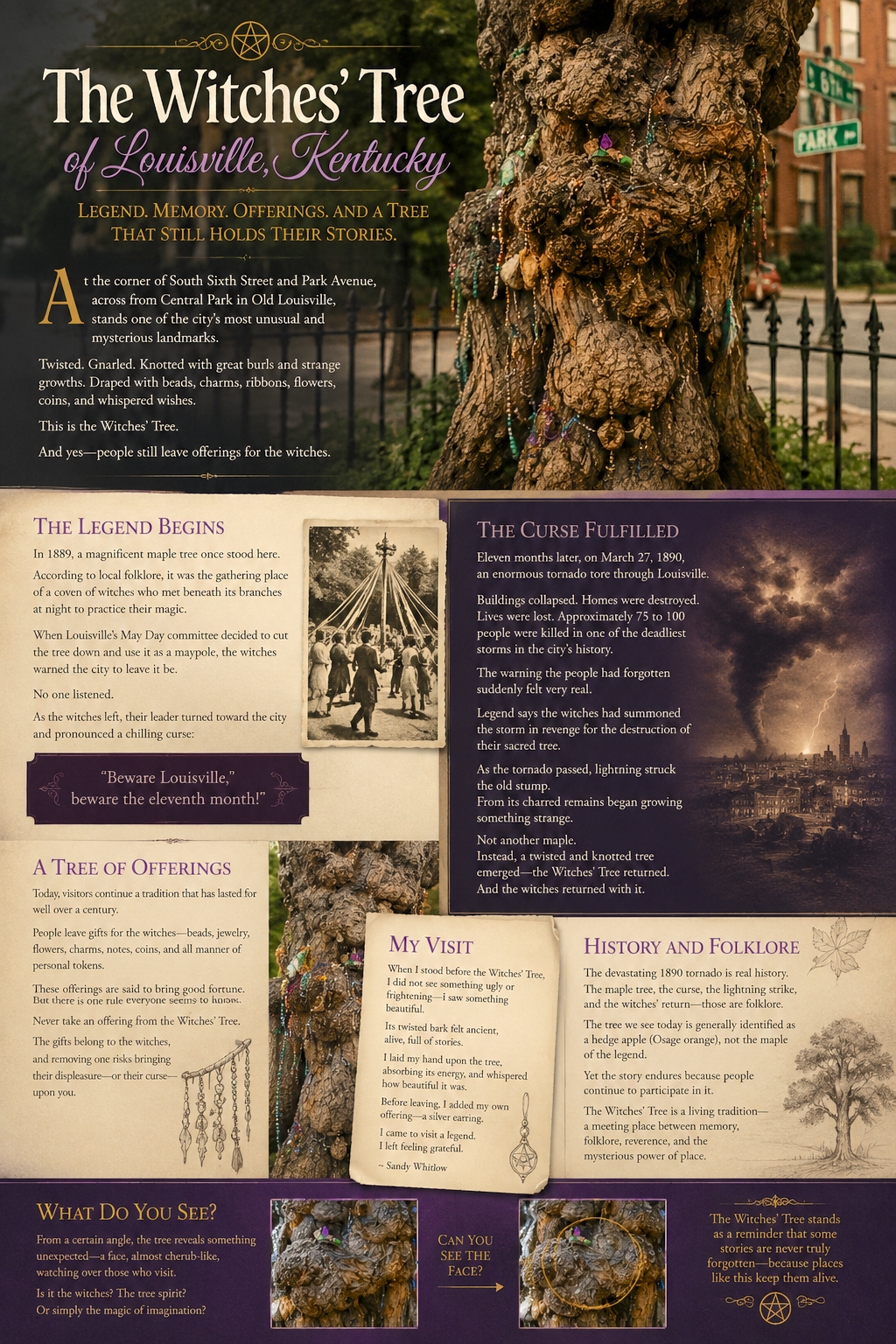
At the edge of Louisville’s Central Park stands a gnarled old tree, covered in beads, charms, jewelry, ribbons, and other offerings. According to legend, it grew from the remains of a tree once sacred to witches—and from the terrible storm that followed its destruction.
We visit some places because history tells us that something happened there; others call to us because the legend insists that something did.
And occasionally, we find a place where history, folklore, memory, and personal experience have become so tightly entwined that separating them almost misses the point.
The Witches’ Tree in Louisville, Kentucky, is one of those places.
I have stood beneath this strange and beautiful tree myself. I have rested my hand against its rough bark, left an offering among the many already given, and wondered about all the people who had stood in that same place before me.
But long before I visited, Louisville had already been telling stories about this tree.
Stories of witches; a warning; a terrible storm; and a tree that, according to legend, refused to stay dead.
A Strange Tree in Old Louisville
The Witches’ Tree stands near the corner of South Sixth Street and Park Avenue, across from Central Park in Louisville’s historic Old Louisville neighborhood; it is difficult to mistake it for an ordinary street tree.
Its trunk is covered in enormous knots and burls. Wood folds over itself into strange shapes, while branches and cavities seem to form faces and figures depending on where you stand and how long you look.
Then there are the offerings; beads hang from branches; small objects are tucked into crevices; and visitors leave jewelry, charms, flowers, coins, ribbons, and personal tokens.
Kentucky Tourism describes these objects as tributes locals leave to appease the witches linked to the tree.
To understand why people continue to leave them, however, we have to return to the nineteenth century—and to a tree that supposedly stood there before this one.
The Witches Beneath the Maple
According to Louisville folklore, a magnificent maple once grew at or near the site of the present-day Witches’ Tree.
The legend says the tree was a gathering place for a coven of local witches. Beneath its branches, they met at night to hold ceremonies and practice their craft.
They apparently caused little trouble.
The tree was their meeting place, and the witches simply wanted to be left in peace.
Then came Louisville’s May Day celebration.
According to the traditional story, city planners decided to cut down the maple and use it as a maypole for the festivities.
The witches objected; they warned the city not to destroy their tree.
Their warning was ignored.
The maple was felled.
Before the witches departed, legend says they left Louisville with a warning:
Beware Louisville. Beware the eleventh month.
Then they were gone.
Eleven Months Later
Nothing happened immediately; Louisville celebrated; days became weeks and weeks became months.
Perhaps anyone who had heard the witches’ warning began to forget it.
And then came March 27, 1890.
Shortly before eight o’clock that evening, a devastating tornado tore into Louisville.
This is where we leave folklore temporarily and enter documented history.
The National Weather Service classifies the Louisville tornado as an F4. It traveled approximately fifteen miles through Jefferson County, Kentucky, and Clark County, Indiana. As it entered Louisville, the tornado widened dramatically and tore through parts of the city. The National Weather Service records 76 deaths and approximately 200 injuries from the tornado.
Louisville’s own historical records offer a slightly different account—78 dead, more than 250 injured, and hundreds of buildings destroyed—illustrating how casualty figures from nineteenth-century disasters can vary across historical sources.
The destruction was horrific.
Five churches, seven railroad depots, three schools, dozens of industrial buildings, and hundreds of homes were destroyed.
One of the greatest tragedies occurred at Falls City Hall on West Market Street, where about forty-four people died when the building collapsed.
The following morning, a Louisville newspaper described the storm with the unforgettable phrase “the whirling tiger of the air.”
The tornado was real; the devastation was real; but Louisville folklore supplied another explanation for why it had happened.
The witches had kept their promise.
The Curse Fulfilled
In the legend, the storm was no ordinary act of nature.
The witches had summoned it.
Eleven months after their sacred tree was destroyed, they unleashed the storm to punish Louisville.
And somewhere amid the chaos, according to the story, lightning struck what was left of the witches’ maple.
From that damaged place, something began to grow; not another graceful maple, but something twisted, knotted, and strange.
The Witches’ Tree had returned.
Kentucky Tourism preserves this version of the legend: after the witches cursed Louisville, a terrible storm arrived eleven months later; lightning struck the stump, and a new, misshapen tree eventually grew from the remains.
It is a wonderful story, but it is important to distinguish folklore from what can be documented.
History and Folklore
There is no reliable historical evidence that a nineteenth-century coven gathered beneath a maple at this location, that city officials cut down their sacred tree, or that witches pronounced a curse upon Louisville.
Nor should we confuse the supernatural explanation of the tornado with the historical event itself.
The March 27, 1890, tornado is exceptionally well documented, whereas the witches’ curse is considered folklore.
Yet folklore deserves to be studied, not because it necessarily tells us what literally happened, but because it sometimes tells us what a community chose to remember.
And the Witches’ Tree is an extraordinary example.
The tree standing there today is generally identified as an Osage orange, sometimes called a hedge apple, rather than the maple in the original story. Yet generation after generation has continued to associate this strange tree with the witches who supposedly once gathered there.
Eventually, people began leaving gifts, and that is where the story becomes something more than a legend.
Leave Something. Never Take Something.
Visitors still leave offerings on the Witches’ Tree; some do so for fun, while others participate because they appreciate the folklore, and some may regard the tree as genuinely spiritual and sacred.
The motivation almost doesn’t matter; it’s the act itself that has become part of the tradition.
Kentucky Tourism notes that people continue to leave small tributes around the tree, effectively choosing to remain on the good side of Louisville’s legendary witches.
And there is an equally important warning attached to the custom:
Do not take what someone else has left.
An offering belongs to the witches.
According to the lore surrounding the tree, removing it risks inviting the very thing those offerings are meant to prevent—their displeasure.
There is something fascinating about that.
More than a century after the supposed witches disappeared, people are still leaving gifts for them.
An Ancient Idea in a Modern City
The practice may seem unusual, but leaving offerings at trees is hardly a modern invention.
Across cultures and centuries, certain trees have been regarded as places of spiritual significance. People have tied cloth to branches, left coins, placed flowers, made petitions, whispered prayers, and approached particular trees as places where the human and supernatural worlds somehow touch.
That does not prove an ancient religious connection to Louisville’s Witches’ Tree, but it places what happens there within a much larger human tradition.
We make certain places sacred by returning to them, and by telling their stories.
We leave something of ourselves behind, and sometimes the ritual endures even after people have forgotten exactly why it began.
A delicious irony is also embedded in the Louisville legend: the witches’ supposedly sacred tree was destroyed for May Day.
The maypole and May Day festivities themselves belong to a complicated history of European seasonal celebration, greenery, springtime, community ritual, and folk custom.
Within the legend, a tree belonging to witches is destroyed to create another ritual object—a maypole.
One tradition replaces another, and then nature takes revenge.
Whether that symbolism developed intentionally or simply accumulated as the story was retold, it lends the legend remarkable depth.
My Own Visit to the Witches’ Tree
When I finally stood before the Witches’ Tree, I did not find it grotesque; I thought it was beautiful.
There was something almost ancient about its distorted trunk—the knots, folds, scars, and enormous burls giving it a character unlike that of any ordinary tree growing along a city street.
I rested my hand against its bark, and for a few moments I simply stood there, wanting to absorb some of the tree’s energy and experience the place rather than merely photograph it.
Then I quietly whispered to it: “You are beautiful.”
Before I left, I gave the tree something of mine, a silver earring.
I tucked it among the offerings that others had already left behind.
I wasn’t interested in asking the witches for anything; there was no bargain attached to my gift. It simply felt right to give something to honor the spirit of this beautiful sacred tree.
Perhaps that is what I remember most clearly about standing there. I had come to visit a piece of Louisville folklore, but once my hand rested against that extraordinary old tree, the experience felt more personal.
For one small moment, I wasn’t merely reading the legend; I was participating in it.
The Face in the Tree
Later, while looking at my photographs, I noticed something else: from one particular angle, the knots and folds in the upper-right portion of the trunk seem to form a face.
Once I saw it, I couldn’t unsee it.
There appears to be a rounded forehead, shadowed eyes, a small nose, and hints of cheeks and a mouth, which, to me, look surprisingly gentle—almost cherub-like.
Of course, there is a perfectly ordinary explanation for this.
Human beings are exceptionally good at recognizing familiar forms in random patterns, especially faces. This phenomenon is known as pareidolia. We see faces in clouds, rock formations, flames, old buildings, and tree bark.
I know that, and yet, I still see the face.
That is one of the things I love about places like the Witches’ Tree; recognizing the rational explanation does not require us to surrender our sense of wonder.
Is it simply the peculiar growth pattern of an old Osage orange?
Almost certainly.
But standing before a tree generations have associated with witches, curses, storms, offerings, and supernatural power, finding what looks like a small face peering from its ancient folds feels wonderfully appropriate.
I’ll let you decide what you see.

Did the Witches Really Curse Louisville?
Probably not.
But perhaps that is the wrong question.
We can establish that a catastrophic tornado struck Louisville on March 27, 1890, and document its path, the destruction it caused, and the lives lost.
We cannot similarly establish that witches summoned it.
Yet more than 130 years later, people still visit a tree across from Central Park, leaving offerings.
That matters, because folklore has a history of its own.
A story repeated for generations becomes tied to a landscape. The landscape then reinforces the story. Eventually, visitors participate in traditions created by people they will never meet.
The Witches’ Tree is therefore not simply an artifact of an old Louisville legend; it is living folklore.
Every bead placed on a branch adds something; every coin tucked into the bark continues the tradition; every person who warns another visitor, don’t take anything from the tree, retells a fragment of the story; and somewhere among all those offerings is a silver earring I left behind.
Perhaps it is still there; perhaps it isn’t; it’s not something that I need to know; I gave it to the tree, and I have no intention of asking for it back.
A Note for Visitors
The Witches’ Tree stands near Park Avenue and South Sixth Street in Old Louisville, across from Central Park. The tree is adjacent to private property, so visitors should be respectful of the surrounding residents and property.
If you visit, look closely at the trunk; you may see nothing more than the magnificent scars and burls of an unusual old tree, or perhaps you’ll see the face I saw.
Either way, if generations of Louisville folklore have taught us anything, there is one piece of advice worth remembering:
Leave something if you wish.
But never take something that was left for the witches.
Don’t be Shy. Leave a Reply! Your comments, thoughts and suggestions for new posts are welcome.