


Some places seem reluctant to let history go.
Old stones hold stories. Floorboards creak beneath the weight of generations long gone. Legends settle into buildings until distinguishing what happened from what people remember becomes almost impossible.
In the quiet Essex village of St Osyth, one such place stands.
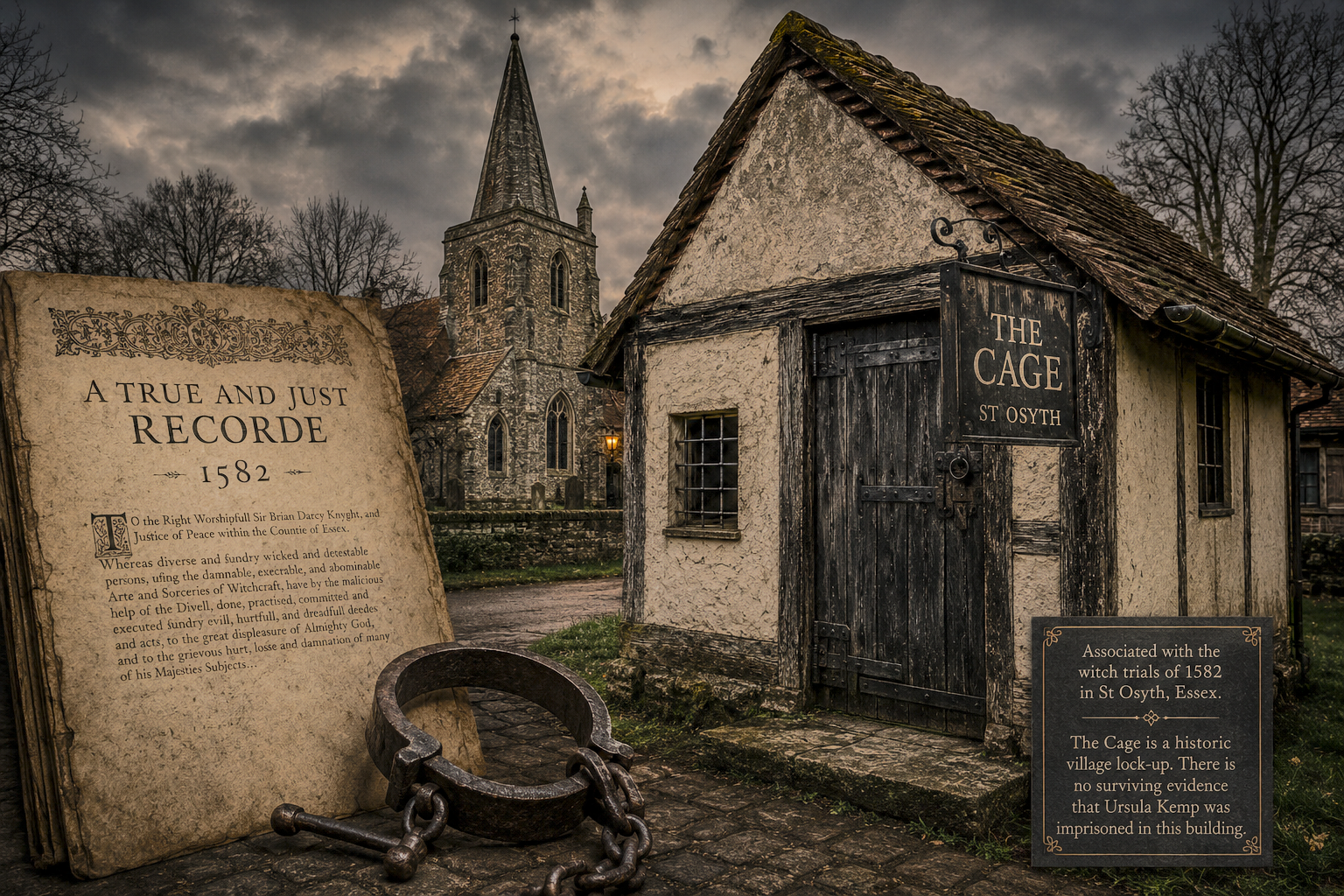
It is known as The Cage.
Today, the small historic building is famous for ghost stories and paranormal investigations, but its darker reputation dates back much further. For generations, The Cage has been associated with the St Osyth witch trials of 1582, particularly with a local healer and midwife named Ursula Kemp.
According to tradition, Ursula was imprisoned in The Cage before being taken away to face the accusations that would ultimately cost her life.
But we need to understand something important before stepping into this story.
We do not know for certain that Ursula Kemp was imprisoned there.
Strangely enough, I think that uncertainty makes the story of The Cage even more fascinating.
Before the Ghost Stories Came the Accused
The building known today as The Cage was historically associated with St Osyth’s village lock-up—a place where prisoners could be temporarily detained before being transferred elsewhere.
Village lockups were rarely grand structures. Their purpose was simple: to confine.
Yet sometime during the centuries that followed the witch trials, The Cage became intertwined with the story of the women accused of witchcraft in St Osyth.
Among them, the most famous was Ursula Kemp.
Ursula was not initially regarded merely as the terrifying figure we might imagine when hearing the word witch. Like many women who later found themselves accused of witchcraft, she possessed skills that her neighbors apparently found useful.
She worked as a nursemaid and healer and seems to have developed a reputation for treating illness.
And therein lay one of the terrible contradictions surrounding folk healers in the early modern period.
If someone believed you had the ability to heal through unusual means, it was not a tremendous leap for a frightened neighbor to believe you also had the ability to harm.
The hands believed capable of curing illness could suddenly be accused of causing it.
The Accusation Against Ursula Kemp
The accusations against Ursula stemmed from tensions between her and another St Osyth woman, Grace Thurlow.
Ursula had previously helped Grace’s son when he fell ill. But the relationship between the women deteriorated, and when misfortune and illness struck Grace’s household, suspicion fell on Ursula.
This was how witchcraft accusations so often began—not with a coven gathered beneath the moon or secret ceremonies hidden deep within the forest, but much closer to home, between neighbors and within communities.
An argument, an unexplained illness, the death of a child, a failed harvest, or even a cow that suddenly stopped producing milk could transform an already strained relationship into something far more dangerous.
When misfortune arrived without an obvious explanation, fear and suspicion often searched for someone to blame.
A neighbor who was already disliked, feared, or considered different could quickly become the focus of that suspicion.
And then came the terrible question: Who caused this?
In February 1582, Ursula Kemp found herself on the wrong side of that question.
When One Accusation Became Many
Once Ursula was accused, the investigation expanded at frightening speed.
Local magistrate Brian Darcy became deeply involved in examining the suspected witches. The surviving evidence places Ursula’s interrogation at nearby St Clere’s Hall rather than definitively inside The Cage.
From there, accusations spread beyond one woman and one household.
Names produced other names, and suspicions became testimony.
The investigation eventually reached the communities surrounding St Osyth as fear spread through northeastern Essex.
Among the witnesses used against Ursula was someone who should never have been placed in such a position… Her own young son.
He testified about his mother’s alleged witchcraft and described several spirits or familiars associated with her. They reportedly appeared in animal form—including cats, a toad, and a lamb. Imagine that for a moment.
A mother sitting accused of witchcraft while testimony from her own child helped build the supernatural case against her.
Whether those statements reflected a frightened child’s beliefs, adult questioning, suggestion, pressure, or some combination of these factors, we can never fully reconstruct it.
But their consequences were devastating.
Ursula eventually confessed and implicated others.
And the accusations multiplied.
The St Osyth Witches
What began as local suspicion became one of the most remarkable witchcraft prosecutions in Elizabethan England.
More than a dozen suspected witches became ensnared in the investigation surrounding St Osyth and neighboring communities.
Ultimately, Ursula Kemp and Elizabeth Bennet were hanged.
Others were imprisoned, and historical research indicates that several of the accused died while incarcerated.
Behind each of those names was a human being. A woman who had neighbors, perhaps children, perhaps someone who loved her, perhaps someone who feared her, or perhaps both.
This is easy to forget when witch trials are transformed into Halloween stories and haunted-house legends.
The accused become “witches.” Their prisons become tourist attractions, their supposed familiars become spooky illustrations, and their deaths become part of folklore.
But these women were real.
So Was Ursula Kemp Actually Imprisoned in The Cage?
This is where history gets complicated.
Local tradition has long held that The Cage was where Ursula Kemp was confined during the investigation.
But historians must distinguish between tradition and evidence.
There is currently no known surviving primary source that explicitly states the following:
Ursula Kemp was imprisoned in this building.
St Osyth Museum itself acknowledges the tradition but notes the lack of documentary evidence confirming it.
We know Ursula was interrogated at St Clere’s Hall; we know she was imprisoned, we know she was eventually taken to trial, and we know she was executed.
But exactly where she was confined during every stage of that journey is much less certain.
That does not necessarily mean the tradition is false; it means we cannot prove it.
And for me, this is where The Cage becomes something more interesting than a simple “witch prison.”
It becomes a place of cultural memory.
When Folklore Becomes Part of a Place
Perhaps Ursula stood inside those walls;; perhaps another accused woman did, or perhaps the connection developed generations later as villagers tried to give physical form to one of the darkest episodes in their community’s history.
We simply do not know.
But what matters is that somewhere along the way, The Cage became inseparable from the women of 1582.
Folklore is not always a precise record of what happened. Sometimes it records what a community simply could not forget.
Over time, buildings and landscapes can become anchors of collective memory, giving physical form to stories passed down from one generation to the next.
A doorway becomes the one she walked through, a room becomes the one where they kept her, or a patch of earth becomes the place where the witch was buried.
As decades turn into centuries, the boundaries between landscape, memory, and legend can become increasingly difficult to distinguish.
In that sense, The Cage may tell us two histories at once: the first is the very real history of witchcraft persecution in Elizabethan England, and the second is the story of how later generations remembered, retold, and gave that history a physical home.
And Then Came the Ghosts
Perhaps inevitably, a building with such a reputation eventually accumulated another layer of folklore.
The Cage has become famous in modern times for reports of paranormal activity and has been described as one of Britain’s most notoriously haunted houses.
Former occupants and visitors have reported unexplained experiences, and paranormal investigators have been drawn to the property.
But this is where I think we should tread carefully.
Ghost stories are fascinating.
I certainly understand their appeal.
Yet there is a danger when places connected with witch trials become known primarily because they are “haunted.”
The tragedy can disappear behind the entertainment.
Ursula Kemp was not a horror character, and Elizabeth Bennet was not part of a ghost story; they were women living in a society where accusations of supernatural harm could mean life or death.
Whatever may—or may not—walk through The Cage today, the most haunting chapter of its story occurred in 1582.
The Real Haunting of St Osyth
When I think about The Cage, I find myself less interested in asking whether a ghost still walks its halls than in asking another question:
Why do we still remember Ursula Kemp more than four centuries later?
Perhaps places like The Cage haunt us because they remind us how quickly fear can turn neighbors into enemies, and how easily suspicion can become evidence.
How vulnerable healers, outsiders, difficult women, poor women, elderly women, and anyone believed to possess unusual knowledge could become when a community desperately needed someone to blame.
The story of St Osyth is filled with all the elements we now associate with witchcraft—familiars, healing, curses, confessions, accusations, and mysterious deaths.
But beneath all that imagery lies something much more frightening — Human fear and suspicion.
And human beings deciding that another person was responsible for things they could not understand.
The Cage endures as a physical reminder of that world.
Whether Ursula Kemp ever looked through its doorway, slept on its floor, or touched its walls may never be known for certain.
But her story has become part of the place, and perhaps that is why The Cage continues to fascinate us — not simply because people say it is haunted, but because the names of the accused have never fully left it.
A Special Shout-Out to Amy and Jarrad of Amy’s Crypt
Before I leave The Cage behind, I want to give a very special shout-out to its current owners and directors, Amy Waine and Jarrad Cutting of Amy’s Crypt.
I have been watching Amy and Jarrad’s paranormal adventures for several years, so seeing them become the owners and directors of a place with such an extraordinary—and complicated—history has been especially exciting to watch.
What I appreciate most is the tremendous effort they have put into restoring The Cage and preserving its character.
Buildings like this are more than old timber, plaster, and brick; they are physical links to the people and communities that came before us. Once they are lost, a piece of that history disappears with them.
The Cage carries layers of history: the documented story of St Osyth, centuries of local tradition, the memory of the 1582 witch trials, and the paranormal legends that have grown around the building.
Amy and Jarrad have approached its restoration with such love and care, all the while continuing to explore those layers and share the journey with people around the world.
For someone like me, who is fascinated not only by the history of witchcraft but also by the ancient buildings and places that still carry these stories, watching The Cage come back to life has been wonderful.
So, Amy and Jarrad, if you ever happen to stumble across this little corner of Chronicles of Witchery, thank you.
Thank you for taking on such an enormous restoration, for preserving this remarkable building, and for letting the rest of us follow along as you uncover its history, room by room—and perhaps ghost by ghost.
And from one longtime Amy’s Crypt viewer…
I cannot think of two more fitting people to have become the next chapter in the story of The Cage.
A Question for My Fellow Seekers
If you stood before The Cage at St Osyth, knowing its history, what would affect you more—the possibility that the building might be haunted, or the knowledge that more than four centuries ago, real women from this small community were accused, imprisoned, and in some cases died because their neighbors believed they were witches?
And what other places connected with witch trials would you like me to explore here in Chronicles of Witchery?
History leaves traces everywhere. Sometimes we only need to know where—and how—to look.
Don’t be Shy. Leave a Reply! Your comments, thoughts and suggestions for new posts are welcome.