

In America, the word witch seems permanently etched into the landscape. Sometimes that connection was forged in a seventeenth-century courtroom, where being called a witch could end in imprisonment or death. In other places, the association appeared much later, after an unusual gravestone, an abandoned building, a mysterious architectural feature, or generations of whispered stories transformed an ordinary location into something decidedly less ordinary.
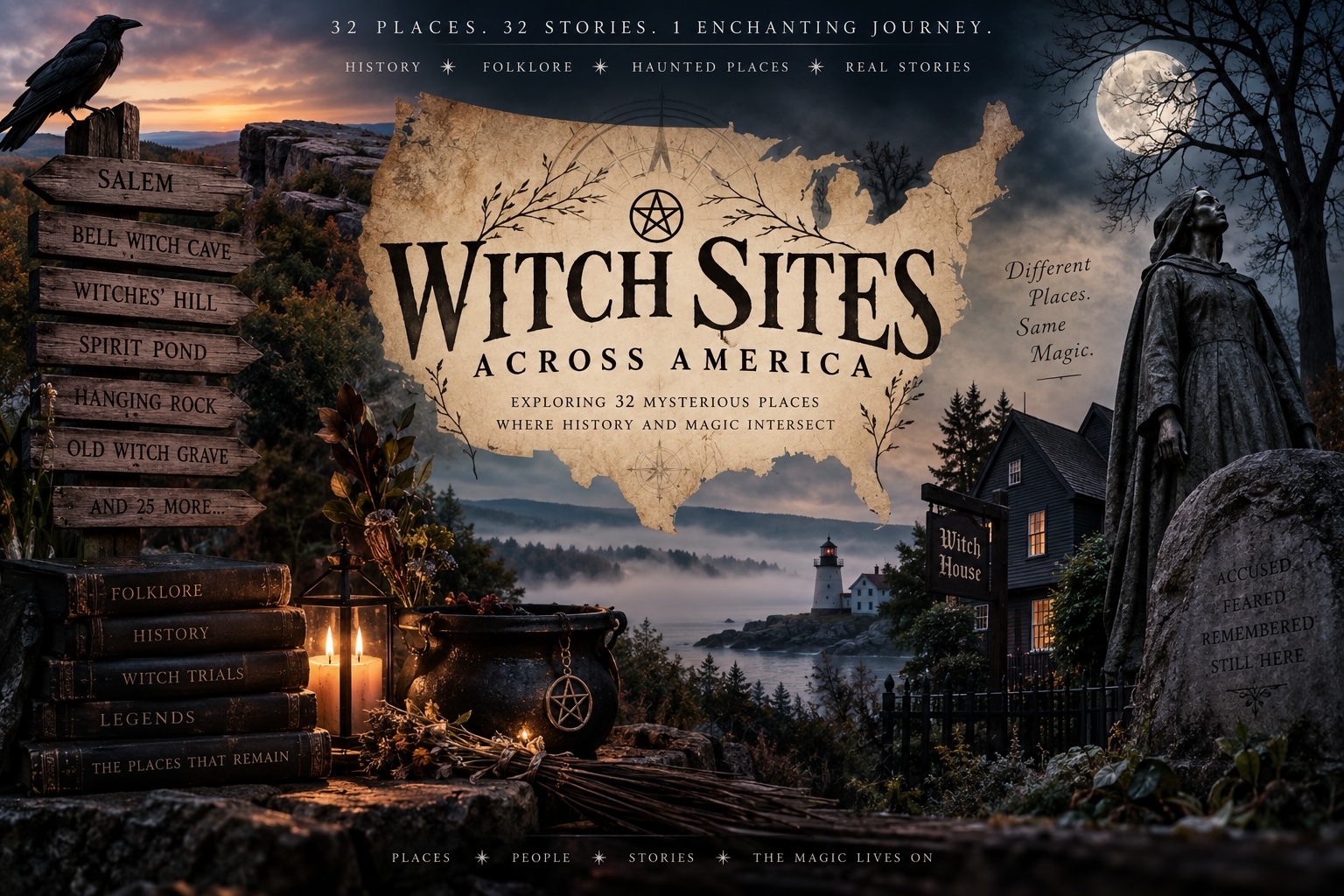
Atlas Obscura currently identifies thirty-two places in the United States under its “Witches” tag. What makes the collection so fascinating is that these places do not share a single kind of witch history. Some preserve documented events from the American witch persecutions. Others commemorate people accused of witchcraft. Several are places where folklore created a witch long after the supposed witch had died, while still others owe their place on the list to literature, television, architecture, Spiritualism, or ghost stories.
Together, they show us something greater than thirty-two curious destinations; they show us how America has repeatedly reinvented the witch.
So rather than simply asking: Where are America’s witch sites? I want to ask a more interesting question at every stop: Why do we call this place witchy at all?
1. The Witch’s Grave — Katy, Texas
Inside Magnolia Cemetery in Katy lies the grave of Barbara Snyder, a German immigrant who died in 1911. Nothing currently documented about Snyder’s life connects her to witchcraft, occultism, or magical practice. Nevertheless, generations of local residents have come to know her resting place by a far more dramatic name: the Witch’s Grave.
The story appears to have grown from the epitaph carved on her marker. Its warning to passersby that they, too, must someday die was not unusual in Victorian and early twentieth-century funerary culture, when gravestones often encouraged visitors to contemplate mortality. Removed from that context, however, the inscription sounds ominous enough to inspire a ghost story.
Local tradition grew around the belief that anyone reciting the inscription should leave a coin or other offering on the grave. Those who failed to “pay the witch” were said to invite bad luck. Another legend holds that someone looking into a mirror near the grave may see a mysterious figure standing behind them. A crystal ornament once associated with the monument acquired its own stories, including claims that it moved or glowed.
What fascinates me about Barbara Snyder is that her story shows how folklore can create a witch. Apparently, there was no historical witch to begin with. There was a woman, a grave, an eerie epitaph, and eventually generations of storytellers.
Why the witch tag? Not because Barbara Snyder was known to practice witchcraft, but because local legend transformed her grave into a ritualized “witch’s grave.”
2. The Daniels House — Salem, Massachusetts
The Daniels House belongs to a very different category. Built around 1667, it predates the Salem Witch Trials by approximately twenty-five years and remains one of Salem’s oldest surviving houses. Today it functions as an inn, but the building retains architectural details that transport visitors into the world in which the 1692 crisis occurred.
One particularly intriguing feature is the presence of what have been described as protective marks, sometimes called apotropaic or “witch marks,” carved into parts of the structure. These marks were not evidence that witches occupied a house. Quite the opposite: in early modern Britain and colonial communities, certain marks were sometimes placed near fireplaces, doors, windows, and other vulnerable openings because people believed they might protect a household against harmful supernatural forces.
That distinction is important.
The people who feared witches often lived within a much broader supernatural worldview than we do today. Witchcraft, providence, demons, spirits, omens, charms, protective symbols, and divine punishment could all coexist within a person’s understanding of the universe.
The Daniels House therefore allows us to encounter not merely “witch history” but something subtler—the world of belief that made witch accusations plausible.
Why the witch tag? Its age places it squarely within Salem’s seventeenth-century world, while its alleged protective markings offer a tangible link to early beliefs about supernatural danger.
3. The Witch House of Belleville — Belleville, Kansas
The Witch House of Belleville shows how quickly history, rumor, and haunted-house folklore can become intertwined.
According to Atlas Obscura, the house dates to the late nineteenth century and gained its reputation in part because a succession of reclusive women reportedly lived there. Over time, townspeople began calling it the Witch House, although there appears to be no documented historical witch trials or confirmed practicing witch associated with the property.
Stories about the house include unexplained lights, whispered voices, singing, strange odors, figures moving behind windows, and vehicles supposedly acting strangely near the property. Like so many haunted-house legends, the individual stories may vary depending on who tells them.
This is important because folklore rarely has a single author. It accumulates over time.
One person tells a story about a light in the window. Another remembers hearing that an eccentric woman once lived there. Someone else calls her a witch. Teenagers dare one another to drive past the property after midnight. Eventually, the nickname becomes better known than the actual history.
The house is privately owned, a point worth emphasizing for anyone tempted to investigate. Witch tourism should never become trespassing.
Why the “witch” tag? The “witch” designation stems from local folklore and the house’s haunted reputation, not from a documented witch trial or a documented history of witchcraft.
4. Lancaster County Courthouse — Lancaster, South Carolina
The old Lancaster County Courthouse holds one of the strangest claims on this list: it has been associated with what local tradition calls the last witch trial in the United States.
The building now standing dates to 1828 and is the Lancaster History Museum. The witch story, however, concerns events said to have occurred earlier on or near the site. According to nineteenth-century accounts cited in the local tradition, a woman named Barbara Powers was accused of extraordinary supernatural crimes. She was said to have transformed a young girl into a horse, ridden her from place to place, and even shrunk herself small enough to enter shops through keyholes to steal goods.
It is wonderfully bizarre folklore, but there is a major historical problem: although references to the allegations survive, Atlas Obscura notes that no trial or verdict record has been found that conclusively verifies the supposed witch trial.
That uncertainty actually makes the site more interesting.
By the nineteenth century, formal witch prosecutions had largely disappeared from American law, but belief in witches had not vanished from rural communities. Stories of shape-shifting, riding victims at night, stealing milk or crops, causing illness, and entering houses through impossibly small openings persisted long after colonial courts stopped hanging people for witchcraft.
Why the witch tag? Because local historical tradition associates the location with a supposed late American witch trial, although the courtroom story remains unverified.
5. Witch Board Museum — Baltimore, Maryland
The Witch Board Museum introduces us to an entirely different branch of occult history: the talking board, better known by its most famous commercial name, Ouija.
Talking boards emerged from the nineteenth-century Spiritualist movement, when enormous numbers of Americans and Europeans became fascinated by the possibility of communicating with the dead. Séances, table turning, automatic writing, spirit photography, mediums, planchettes, and talking boards all became part of that world.
Baltimore played a particularly important role. Around 1890, businessman Charles Kennard and his associates began producing talking boards commercially, while attorney Elijah Bond secured the patent for what became the Ouija board. According to the famous origin story, the board itself supposedly supplied the name “Ouija” during a session.
The Baltimore museum, opened in 2024 as a companion to the Salem Witch Board Museum, preserves examples and the history of these devices.
Strictly speaking, Ouija boards are not historically products of witchcraft. They belong much more directly to Spiritualism and popular attempts at spirit communication. Yet twentieth-century horror films and occult culture gradually blended séance practices, witches, demons, possession, and talking boards into the public imagination.
Why the witch tag? Because modern occult culture has absorbed the Ouija board into the wider world, which is popularly associated with witches, divination, spirits, and supernatural practice.
6. The Three Brujas — Taos, New Mexico
Among the graves at Kit Carson Cemetery in Taos lie three unusual, unmarked concrete tombs traditionally known as those of Las Tres Brujas—the Three Witches.
Local legend claims that three witches were buried there after inflicting terrible harm on the community. The striking problem is that no one seems to know exactly who the women were—or precisely what they supposedly did. Atlas Obscura notes that even the alleged evil the mysterious women committed has been lost from living memory.
That absence is almost more fascinating than a complete story would be.
We are left with three graves and an accusation without biographies.
Who were these people?
Were they women feared in their lifetimes? Were the graves merely unusual enough to spark a legend? Did the story develop decades later? Did older Hispanic or regional folk beliefs become attached to them?
The word bruja also reminds us that American witch history cannot be understood solely through the lens of Puritan New England. Spanish and Mexican folk traditions, Indigenous beliefs, Catholic supernaturalism, African diasporic traditions, and regional healing practices all contributed to the many ways Americans have imagined magical practitioners.
Why the witch tag? Because longstanding Taos folklore identifies the three mysterious graves as belonging to brujas, even though their identities and histories remain uncertain.
7. South End Burying Ground — East Hampton, New York
Long before Salem erupted in 1692, Goody Garlick was accused of witchcraft on Long Island.
The case began when Elizabeth Gardiner Howell became seriously ill and, in delirium, accused Garlick of attacking her through witchcraft. After Howell died, suspicions about Garlick intensified as neighbors began attributing other misfortunes to her.
What happened next makes this case unusual.
Lion Gardiner, Elizabeth’s father and one of East Hampton’s most influential figures, arranged for Garlick’s case to be heard in Connecticut. Rather than joining the growing fury against her, Gardiner appears to have sought a legal process that offered her a better chance of survival.
Garlick was not convicted.
She returned to East Hampton and spent the rest of her life there. Both she and Lion Gardiner are believed to be buried in South End Burying Ground, although Garlick’s grave is unmarked.
This graveyard therefore commemorates something surprisingly rare in popular witch history: an accusation that did not end at the gallows.
It reminds us that witch trials were not inevitable tragedies. Human choices mattered. Magistrates could reject weak evidence. Neighbors could resist hysteria. Authorities could say no.
Why the witch tag? Because the burying ground contains the remains of Goody Garlick, an accused colonial witch who survived, and of Lion Gardiner, whose actions helped prevent her execution.
8. Ashland Witch Caves — Ashland, Massachusetts
Deep within the Ashland Town Forest lie rock formations traditionally known as the Witch Caves.
According to local tradition recorded by Atlas Obscura, the caves sheltered people fleeing the expanding Salem witch crisis. The most prominent figure associated with the story is Sarah Clayes, sister of Rebecca Nurse and Mary Easty, both of whom were executed in 1692. Sarah herself was accused and imprisoned.
The story links the caves to land controlled by Thomas Danforth, an important Massachusetts political figure who became associated with people fleeing the witch trials. Settlers eventually established themselves in an area known as “Salem End,” which later became part of Framingham.
The physical caves described in the tradition have largely collapsed, so visitors today encounter rock formations rather than a perfectly preserved seventeenth-century hiding chamber.
Yet imagine the emotional reality beneath the legend.
If your sister had been hanged as a witch and another sister was awaiting the same fate, where would you feel safe?
In your home?
At church?
Before a magistrate?
Or hidden among rocks in the forest?
Why the witch tag? Because local historical tradition identifies the caves as refuges for people fleeing the Salem prosecutions, particularly Sarah Clayes and her family.
9. Sarah Clayes House — Framingham, Massachusetts
Sarah Clayes gives us something that witch-trial histories do not always spend enough time considering: what happened afterward.
Sarah Towne Clayes was the sister of Rebecca Nurse and Mary Easty, two of the most recognizable victims of the Salem trials. All three sisters were suspected. Rebecca and Mary were executed; Sarah survived.
According to tradition surrounding the Framingham property, Sarah and her husband, Peter, eventually settled on land associated with Thomas Danforth. Other refugees from the Salem crisis also settled nearby, helping form the community known as Salem End. Around 1700, the area became part of the new town of Framingham.
The house associated with Sarah was restored after periods of deterioration and remains a private residence today.
Her story invites questions we rarely ask.
How does someone live after surviving a witch hunt that killed two sisters?
How do you return to ordinary domestic life after imprisonment?
Could Sarah ever again trust neighbors, ministers, courts, or communities in quite the same way?
The trials did not end for survivors when the prosecutions stopped.
Why the witch tag? The house is associated with a woman accused during the Salem crisis who escaped execution and rebuilt her life among others affected by the persecutions.
10. Old North Burying Ground — North Andover, Massachusetts
One of the greatest misconceptions about 1692 is that the crisis was confined to Salem.
It did not.
Andover experienced an extraordinary explosion of accusations, eventually producing more accused people than Salem did.
The trouble included accusations against Martha Carrier, who was eventually executed on August 19, 1692. As panic spread, authorities even used the notorious “touch test.” The theory behind the test held that if an afflicted person recovered when touched by the accused, the recovery somehow demonstrated that the accused had caused the affliction.
It was circular reasoning posing as supernatural evidence.
More than forty people associated with the Andover outbreak were accused, and Martha Carrier, Mary Parker, and Samuel Wardwell were among those ultimately executed. As the crisis escalated, Reverend Francis Dane emerged as a prominent critic of the proceedings.
The Old North Burying Ground contains the remains of people connected with several sides of the affair—figures involved in the accusations as well as those who challenged them.
Why the witch tag? The cemetery is one of the few surviving landscapes directly linked to the Andover witch panic, a branch of the 1692 crisis often overshadowed by Salem.
11. Salem Witch Trials Memorial — Salem, Massachusetts
Amid Salem’s shops, costumed tours, museums, and Halloween celebrations, a place stands where the story grows quiet.
The Salem Witch Trials Memorial was dedicated in 1992, marking the three-hundredth anniversary of the trials. Stone benches commemorate the twenty people who died as a result of the prosecutions, recording their names, dates, and manner of death.
Nineteen people were hanged.
Giles Corey died after being pressed under heavy stones for refusing to enter a plea.
The threshold contains fragments of the accused’s words, symbolically interrupted by the memorial walls—an architectural reminder of voices that were ignored. Visitors frequently leave flowers, coins, written notes, and other memorial tokens.
For me, this is where one of the most important distinctions in witch history must be drawn.
The people commemorated here should not be casually described as historical witches.
They were accused of witchcraft.
Many rejected the accusation, to their deaths.
Modern witches can reclaim the word with pride, but we should never inadvertently impose that modern identity on people who were killed precisely because others forced the label on them.
Why the witch tag? Because the memorial commemorates the victims of America’s most infamous witchcraft prosecution.
12. Memorial to Alse Young and Lydia Gilbert — Windsor, Connecticut
If Salem is America’s most famous witch trial, Connecticut reminds us that it was not America’s first.
Alse Young of Windsor was executed for witchcraft on May 26, 1647, making her the first person known from surviving records to have been executed for witchcraft in New England. This occurred forty-five years before Salem.
Remarkably little documentation of her accusation survives. Historians have proposed possible links to disease outbreaks or community tensions, but we simply do not know exactly what was claimed she had done.
Nearby, Windsor also commemorates Lydia Gilbert, another woman executed for witchcraft in seventeenth-century Connecticut.
Their modern memorials are modest brick markers rather than enormous monuments. That simplicity seems somehow appropriate. For centuries, women like Alse Young disappeared almost entirely from popular memory while Salem became synonymous with American witch persecution.
Recent historical work has helped recover their stories, and Connecticut has taken steps toward formally recognizing the injustice done to those accused and executed during its witch-hunting period.
Why the witch tag? These memorials honor two women who were actually executed for witchcraft decades before the Salem trials made such prosecutions infamous.
13. Buckner Mansion — New Orleans, Louisiana
The Buckner Mansion has no colonial witch trial associated with it.
Its witches came from TV.
Built in 1856 for wealthy cotton merchant Henry Sullivan Buckner, the grand Garden District mansion was designed in part to outshine the home of Buckner’s former business partner and rival. It later served as the Soule Business School before returning to private residential use.
Then Hollywood arrived.
In 2013, the mansion became Miss Robichaux’s Academy for Exceptional Young Ladies in American Horror Story: Coven. Within the series, the house served as a school and refuge for young witches learning to control their supernatural abilities. It reappeared when characters from Coven returned in the show’s later Apocalypse season.
New Orleans was an inspired setting. The city’s authentic supernatural heritage encompasses Voodoo, Hoodoo, Spiritualism, Catholic devotional practice, African diasporic traditions, ghost lore, occult communities, and centuries of storytelling.
But the Buckner Mansion’s specific witch identity is fictionalized.
Why the witch tag? Because popular culture turned the historic mansion into one of television’s most recognizable modern witch houses.
14. Rice Family Mausoleum — New Orleans, Louisiana
The Rice Family Mausoleum symbolizes the literary witch.
Anne Rice was born in New Orleans, and the city became almost a character in its own right throughout her Gothic fiction. While she became internationally famous for The Vampire Chronicles, witches also play a major role in her fictional universe, particularly through the Mayfair family in The Witching Hour, Lasher, and Taltos.
Rice’s relationship with New Orleans ran deep. Houses she owned and neighborhoods she knew echoed in her fiction. After her husband, poet and painter Stan Rice, died, she eventually left Louisiana for California, but New Orleans remained inseparable from her literary identity.
Anne Rice died in December 2021 and was returned to New Orleans for burial in the family mausoleum at Metairie Cemetery, where Stan and their daughter Michele were already interred.
This is not a site associated with historical witchcraft, persecution, or folk magic.
Instead, it commemorates someone who helped shape what millions of modern readers imagine when they hear stories of immortal families, occult powers, vampires, spirits, and witches.
Why the witch tag? Because Anne Rice’s Mayfair novels made her one of the most influential modern literary creators of witch mythology.
15. Coral Cut — Palm Beach, Florida
The Coral Cut showcases the extraordinary storytelling power of an unusual landscape.
Country Club Road cuts through a formation of ancient coral in Palm Beach. Within the rock wall is a small, gated opening that has inspired a number of dark local legends, collectively giving the location the nickname Witch’s Wall.
One version claims that a nearby witch kidnapped children and trapped them behind the gate, imprisoning their souls in the coral. Touching the gate supposedly releases one of the trapped spirits—but risks angering the witch enough to make her claim another victim.
Other versions bear little resemblance to that tale. One involves a grieving woman driven mad after losing her husband. Another claims a woman was imprisoned behind the opening. Still another describes the property as a former asylum.
The mundane explanation is considerably less sinister: the property above the cut contains infrastructure associated with a water pumping station, and the opening serves that practical function.
But a lonely road, coral wall, metal gate, and solitary light are apparently more than enough ingredients to cook up a witch.
Why the witch tag? Entirely because of local folklore about the so-called Witch’s Wall.
16. Proctor’s Ledge — Salem, Massachusetts
For centuries, people spoke vaguely of Gallows Hill as the place where Salem’s condemned were hanged.
The actual story proved more complex.
Historian Sidney Perley studied old maps, topography, eyewitness accounts, and historical records and, in the early twentieth century, concluded that the executions occurred on a lower rise now known as Proctor’s Ledge. Later researchers revisited his conclusions, and in the 2010s a scholarly team announced that the documentary and geographical evidence supported Proctor’s Ledge.
A memorial was dedicated there in 2017, following the city’s formal recognition of the site.
Nineteen people were hanged in this vicinity in 1692. Giles Corey, who was pressed to death, died elsewhere.
What makes Proctor’s Ledge especially affecting is how ordinary it appears today. It sits within a residential neighborhood rather than on some dramatic windswept hill overlooking Salem.
And perhaps that makes the horror feel more real.
Atrocities do not require theatrical settings.
They occur where ordinary people live.
Why the witch tag? Because this is the historically recognized execution site for the nineteen people hanged for witchcraft during the Salem trials.
17. Moll Dyer Rock — Leonardtown, Maryland
The story of Moll Dyer may be among America’s most haunting witch legends.
According to tradition, during the bitter winter of 1697, residents of what is now Leonardtown blamed an elderly, impoverished woman named Moll Dyer for crop failures, dying livestock, disease, and other misfortunes. A group reportedly drove her from her home on a freezing night, and she was later found dead beside or upon a large stone.
Legend claims impressions from her hands or knees remain on the rock.
For generations, the stone itself served as the physical anchor of the story. In the twentieth century, writer Philip H. Love helped relocate a rock believed to be the legendary stone, and it eventually came into the care of local historical organizations. Today it stands near Tudor Hall.
Researchers have sought to uncover the historical woman beneath the folklore, including work suggesting that “Moll” may have been Mary Dyer, born in England in the seventeenth century. Yet significant portions of the traditional story remain difficult to document.
That does not render the legend meaningless.
Instead, it reveals how communities preserve memories of scapegoating.
Why the witch tag? Because local tradition holds that Moll Dyer was accused of witchcraft, driven from her home, and died on the stone now bearing her name.
18. Joshua Ward House — Salem, Massachusetts
The elegant Joshua Ward House was built in 1784, long after the Salem witch trials.
But the land beneath it carries a much darker association.
The house stands on the former property of George Corwin, High Sheriff of Essex County during the 1692 prosecutions. Corwin carried out arrests, seized property, transported prisoners, and participated in the machinery that led accused people toward imprisonment and execution.
The site later became surrounded by supernatural stories, particularly the legend of Giles Corey’s curse. According to later folklore, Corey cursed Sheriff Corwin and Salem as he lay beneath the weight of stones used to force him to enter a plea.
Whether Corey actually uttered the famous curse is another matter. Like many memorable details in witch-trial storytelling, the legend grew more elaborate over generations.
The current Federal-style house has other historical associations as well; George Washington visited it during his presidential travels.
Today, the building operates as The Merchant, a boutique hotel.
Why the witch tag? Not because the current house held accused witches, but because it occupies the former property of George Corwin, one of the officials closely involved in the Salem prosecutions.
19. Salem Village Parsonage — Danvers, Massachusetts
If any place can reasonably be called the starting point of the Salem crisis, it is the Salem Village parsonage.
The house belonged to the village minister, Reverend Samuel Parris. In early 1692, Parris’s daughter Betty and niece Abigail Williams began showing strange symptoms and behavior. Soon, other girls joined them.
When no ordinary explanation satisfied the community, witchcraft was the answer.
Accusations followed.
The first women named were Tituba, Sarah Good, and Sarah Osborne, and from there the crisis spread with frightening speed. The parsonage therefore sits near the origin of a chain of accusations that eventually engulfed communities far beyond Salem Village.
Interestingly, the parsonage had previously housed Reverend George Burroughs, who would later be accused and hanged as a witch in 1692.
The structure disappeared long ago, but archaeological excavations uncovered its foundation. Those remains can still be visited in modern-day Danvers—the town once known as Salem Village.
Why the witch tag? Because the initial afflictions and household events that triggered the Salem witch crisis occurred at the Parris parsonage.
20. Witch’s Hat Depot — South Lyon, Michigan
After nineteen sites associated with accusations, deaths, hauntings, or supernatural beliefs, the Witch’s Hat Depot offers us something refreshingly innocent.
It is called witchy because of its roofline.
The original Pere Marquette depot in South Lyon burned in 1908. A replacement station opened the following year, featuring a distinctive conical roof that residents thought looked remarkably like a witch’s pointed hat.
The railway depot operated for more than forty years, serving travelers and freight across the region before closing in 1955. After decades of vacancy, the structure was purchased, relocated, restored, and incorporated into a historical village. Today, it serves as a museum and community space.
No accused witch was imprisoned here.
No curse hangs over the platform.
No coven met under the roof.
Yet the association tells us something interesting about visual culture. The pointed witch’s hat has become such a powerful symbol that architecture resembling it can instantly acquire a supernatural nickname.
Why the witch tag? Simply because the depot’s conical roof resembles the stereotypical pointed hat of a witch.
21. Witch Windows — Vermont
Anyone traveling through old farming communities in northern Vermont may notice something unusual.
Some nineteenth-century houses have windows installed diagonally, sometimes at about forty-five degrees below the roofline.
Naturally, folklore provided an explanation.
They are called witch windows because, according to legend, witches flying on broomsticks could not pass through a crooked window.
Another nickname—“coffin windows”—spawned an entirely different legend that the openings were designed to remove coffins from upper stories.
The practical explanation is less macabre. As farmhouses expanded and new wings were added, builders sometimes encountered awkward triangular spaces beneath the eaves. Rather than buying or building a custom window, thrifty homeowners could rotate an existing rectangular window and fit it into the available space, gaining ventilation and daylight in the process.
So the witch window is a beautiful example of folklore growing around an ordinary thing.
A farmer recognizes efficient carpentry.
A storyteller sees a magical defense.
I confess I prefer having both.
Why the witch tag? Vermont folklore claims the diagonal windows were designed to keep witches from flying into houses.
22. St. Omer Cemetery Witch Grave — Ashmore, Illinois
Few things inspire folklore faster than an impossible date carved into a grave.
In the nearly vanished community of St. Omer, Illinois, the Barnes family monument lists the name of Caroline Barnes, whose death date is recorded as February 31, 1882.
There is, of course, no February 31st.
From that mystery, a witch legend grew.
Stories claim Caroline was accused of witchcraft and was variously hanged, burned, or buried alive. The spherical feature on the family monument became a “crystal ball” that supposedly glows on dark nights. One especially creative version argues that the impossible date was intentional: the witch could only return on the anniversary of her death, but because February 31 never arrives, she can never rise.
It is marvelous folkloric.
It is not necessarily a biography.
The varying accounts of Caroline’s supposed execution alone should make us cautious. When one legend says she was hanged, another says she was burned, and another says she was buried alive, we are watching oral tradition evolve—not reading a court transcript.
Why the witch tag? Because Caroline Barnes’s unusual monument, orientation, spherical decoration, and impossible death date fueled a rich local legend that identified her as a witch.
23. Witch Dungeon Museum — Salem, Massachusetts
The Witch Dungeon Museum does not belong to seventeenth-century Salem itself but to the much later history of how Salem chose to present 1692 to visitors.
The attraction uses a live reenactment based on a witchcraft examination or trial and then guides visitors through reconstructed dungeon scenes depicting imprisonment and punishment.
Atlas Obscura is irreverent in its assessment of the attraction, describing aging wax figures and theatrical displays rather than treating it as a conventional historical museum.
Yet that makes the site historically interesting in another respect.
By the twentieth century, Salem had begun to transform its traumatic past into tourism. The witch trials became simultaneously history, memorial culture, Halloween entertainment, Gothic spectacle, and, eventually, an important part of the city’s economic identity.
That raises questions worth asking.
How do we teach about tragedy without exploiting it?
Where is the line between interpretation and entertainment?
Can kitsch introduce someone to history, even if they later pursue more reliable scholarship elsewhere?
Why the witch tag? Because the attraction interprets and dramatizes the Salem witch trials for visitors, making it part of Salem’s modern witch-tourism landscape.
24. The Witch’s Castle — Portland, Oregon
The Witch’s Castle looks convincingly wonderful.
Moss coats its crumbling stone. Trees surround it. Empty openings lead to shadowed chambers.
Surely, witches lived there.
They did not.
The story of the land begins with Danford Balch, an early settler whose daughter, Anna, fell in love with hired worker Mortimer Stump. After Balch opposed the relationship, the young couple eloped. Balch later shot Stump and was eventually executed in 1859, becoming associated with one of Oregon’s earliest legal executions.
Decades later, the city acquired the property. In the 1930s, a stone building was constructed there as a park facility, with restrooms and space for a ranger station.
A severe storm damaged the structure in 1962, and nature gradually reclaimed it.
By the 1980s, local teenagers had begun using the ruins as a gathering spot and calling them the Witch’s Castle. The name stuck.
So we have a murder.
Execution.
Abandoned ruins.
Moss.
Teenagers.
But no historical witch.
Why the witch tag? Because later local culture renamed an atmospheric abandoned park structure the Witch’s Castle, despite there being no actual connection to a witch.
25. Gardiners Island — New York
Gardiners Island has an astonishing history dating back nearly four centuries.
Lion Gardiner acquired the island in the seventeenth century, and his descendants have retained the property for generations. Its long history includes colonial settlement, war, buried treasure associated with Captain Kidd—and a witchcraft accusation.
The witch connection is tied to the same family history we encountered at the South End Burying Ground.
Gardiner’s daughter, Elizabeth Gardiner Howell, became seriously ill and, while delirious, accused Goody Garlick of a supernatural attack. Those accusations helped ignite a witchcraft case against Garlick.
Lion Gardiner ultimately played a complicated role. Although the accusation came from within his own family, he helped arrange legal proceedings in a way that contributed to Garlick avoiding execution.
Atlas Obscura describes the episode as an early colonial witch hunt linked to the Gardiner family.
The island remains privately owned and is not a typical tourist attraction.
Why the witch tag? The Gardiner family was directly involved in the seventeenth-century witchcraft accusations against Goody Garlick, one of Long Island’s earliest known cases of witchcraft.
26. The Witch of Pungo Statue — Virginia Beach, Virginia
Grace Sherwood deserves far more attention in American witch history.
Born around 1660, Grace lived in Princess Anne County, Virginia. She married James Sherwood and, according to later descriptions, became a wife, mother, farmer, and healer or nurse.
She also developed a reputation that frightened some of her neighbors.
Accusations claimed that Grace could kill livestock through witchcraft, damage crops, take animal form, and attack people supernaturally. After multiple disputes and accusations, she was formally tried for witchcraft in 1706.
The court subjected her to the ordeal by water.
Grace was tied and placed in the Lynnhaven River, under the belief that pure water would reject a witch. If she floated, it was taken as a sign of guilt.
She floated.
Thankfully, she was not executed. She appears to have been imprisoned, eventually recovered her property, and lived for decades afterward.
Three hundred years later, in 2006, Virginia Governor Tim Kaine symbolically restored her good name. A statue now depicts Grace with rosemary, recalling her association with healing, and a raccoon, symbolizing her connection with animals.
The nearby Witchduck Road still preserves cultural memory of her ordeal.
Why the witch tag? Grace Sherwood was the last person known to have been convicted of witchcraft in colonial Virginia, making this one of the most historically significant witchcraft memorials in America.
27. Grave of Elizabeth Budd-Graham — Tallahassee, Florida
Elizabeth “Bessie” Budd-Graham died in 1889 at the age of twenty-three and was buried in Tallahassee’s Old City Cemetery.
She eventually became known in local folklore as a “white witch.”
Why?
Partly because her grave is unusual.
Her monument faces differently from many nearby Christian burials, and its elaborate design and literary epitaph help make it stand out. The inscription incorporates lines from Edgar Allan Poe’s Lenore, giving the memorial an unmistakably Gothic character.
From those details, stories grew about Elizabeth practicing benevolent magic. Later legends even claimed that she somehow died twice or that unusual circumstances surrounded her burial.
But again, the documentary evidence that Elizabeth practiced witchcraft is thin.
Her transformation into Tallahassee’s “white witch” seems more securely part of folklore than of biography.
She joins Barbara Snyder, Caroline Barnes, and Mary Nasson in a curious sisterhood of American women who acquired witch identities primarily after their deaths.
Why the witch tag? Because of the unusual orientation, Gothic epitaph, monument, and later cemetery folklore, Elizabeth Budd-Graham became Tallahassee’s legendary “white witch.”
28. Rebecca Nurse Homestead and Graveyard — Danvers, Massachusetts
Rebecca Nurse’s story remains one of the most disturbing examples of how far the Salem crisis had moved beyond accusations of social outsiders.
Rebecca was around seventy-one years old, a wife, mother of eight, grandmother, church member, and a longstanding member of her community when she was accused.
Her family also had ongoing disputes with the influential Putnam family, reminding us that witch accusations could intersect with land conflicts, neighborhood tensions, religious disagreements, and old grudges.
At trial, the jury initially returned a verdict of not guilty.
Instead of accepting it, officials asked the jury to reconsider its decision.
They did.
Rebecca Nurse was convicted and hanged on July 19, 1692.
Family tradition holds that her loved ones secretly recovered her body from the execution site and buried her on the family property. Today, a memorial marks the site associated with her grave. The homestead itself preserves the physical surroundings of the Nurse family and contains structures that help visitors understand seventeenth-century domestic life.
The remains of fellow victim George Jacobs Sr. were later reinterred on the property.
Why the witch tag? Because the homestead preserves the home, family landscape, and grave of one of the best-documented victims of the Salem witch trials.
29. York Witch Grave — York, Maine
Mary Nasson died on August 18, 1774.
Her grave in York’s Old Burying Ground features an unusual carved portrait and an affectionate inscription from her husband, Samuel. Yet most visitors are drawn to the heavy stone slab covering the grave.
And from that slab came the story about the witch.
Later folklore claimed the stone had been deliberately placed over Mary’s body to prevent her from rising from the grave.
It sounds wonderfully Gothic.
The historical explanation is far more practical.
Similar grave coverings were used in early New England to protect burials from animals such as pigs and cattle. Other examples may have once existed in the cemetery but disappeared when stones were reused elsewhere.
Furthermore, the legend that Mary was a witch seems to have developed after her death rather than reflecting how her community actually knew her.
Once again, an unusual funerary feature created a witch.
Mary Nasson illustrates why folklore historians constantly ask when a story first appears. A tale recorded a century after someone’s death cannot automatically tell us what neighbors believed during her lifetime.
Why the witch tag? Later generations interpreted the stone covering Mary’s grave as an attempt to imprison a witch, even though the slab likely served an ordinary, practical purpose.
30. Bell Witch Cave — Adams, Tennessee
The Bell Witch is one of the giants of American supernatural folklore.
The story begins on John Bell’s farm in Tennessee around 1817. Members of the Bell family reportedly experienced unexplained knocking, scratching, voices, physical attacks, disturbed bedding, and other frightening phenomena.
Eventually, the unseen entity developed a personality.
It came to be known as Kate or the Bell Witch.
According to later versions of the legend, the spirit particularly tormented John Bell and his daughter, Betsy. Some accounts eventually blamed the entity for John’s death. A famous later story even claims that future president Andrew Jackson visited the property and encountered the supernatural force himself.
The nearby cave became incorporated into the mythology as one of the spirit’s possible dwelling places. Another legend tells of the entity rescuing a child trapped during cave exploration—an oddly benevolent act from an otherwise malevolent presence.
But notice something curious.
The Bell Witch is not really a witch in the conventional historical sense.
She behaves more like a poltergeist, a spirit, a haunting intelligence, or a folkloric entity.
Why the witch tag? Because generations of Southern folklore have named the entity the Bell Witch, even though the phenomenon resembles a haunting far more than a human practitioner of witchcraft.
31. Spadena House — Beverly Hills, California
The Spadena House may be the happiest witch site we encounter on our entire journey.
Built in 1921 by Hollywood art director Harry Oliver, the house originally stood in Culver City as part of the Willat silent-film studio complex. Its distorted roofline, crooked shutters, warped fencing, exaggerated landscaping, and storybook construction gave it the look of something pulled from a fairy tale.
Eventually, the structure was moved to Beverly Hills and converted into a private residence.
Its enormous, drooping roof resembles a witch’s hat, and the surrounding landscaping seems intentionally enchanted. Not surprisingly, residents began calling it the Witch’s House.
Over time, urban legends claimed it had been built for Hansel and Gretel or inspired by Snow White, though those stories are inaccurate. Its genuine film-industry origin is arguably more interesting.
The house became so beloved that a later owner purchased and restored it rather than let redevelopment destroy it.
No one was accused.
No witch was imprisoned.
No curse created the name.
This is the witch in fairy-tale architecture.
Why the witch tag? Because its exaggerated storybook design resembles the culturally familiar home of a fairy-tale witch.
32. The Witch House of Salem — Salem, Massachusetts
Our journey ends at perhaps the most recognizable witch-related building in the United States.
The dark timbered structure at 310½ Essex Street is known as the Witch House, even though no witch ever lived there.
It was Jonathan Corwin’s home.
Corwin was a magistrate and later a member of the special Court of Oyer and Terminer, which heard witchcraft cases in 1692. The court accepted forms of evidence—including spectral testimony—that helped send accused people to their deaths.
Corwin purchased the house in the seventeenth century and lived there for decades. Today, it is regarded as the only surviving building in present-day Salem with a direct link to the officials who participated in the 1692 trials.
Its later history is equally fascinating.
By the nineteenth century, entrepreneurs were already recognizing the commercial appeal of Salem’s witch past. One owner marketed the building as the “Old Witch House,” charged visitors to view its historical features, and even used witch imagery in advertising the products sold there. Salem’s modern witch tourism was beginning long before Halloween crowds filled Essex Street.
That makes the Witch House the ideal place to end.
It connects seventeenth-century prosecution with nineteenth-century memory and with modern tourism.
Why the witch tag? Because the building belonged to Judge Jonathan Corwin, a central figure in the Salem proceedings—not because a witch ever lived there.
Not All Witch Sites Are the Same
After digging more deeply into these thirty-two places, I think we can divide them—conceptually, not formally—into several kinds of American witch sites.
Some are sites of genuine persecution: Proctor’s Ledge, the Rebecca Nurse Homestead, the Salem Village Parsonage, the Alse Young and Lydia Gilbert memorial, Grace Sherwood’s statue, and sites associated with Andover and Goody Garlick.
These locations bring us closest to people who were accused, prosecuted, imprisoned, or executed because their communities believed in witchcraft.
Others are sites of later folkloric tradition.
Barbara Snyder, Caroline Barnes, Mary Nasson, Elizabeth Budd-Graham, the Three Brujas, and perhaps Moll Dyer inhabit a blurrier landscape where documented biography and legend overlap. In several cases, the “witch” may have been created primarily by people who lived long after the woman’s death.
Then there are supernatural witch sites, such as the Bell Witch Cave and Coral Cut, where the witch is primarily part of ghost stories and legends.
We also find cultural witches—Anne Rice’s mausoleum, Buckner Mansion, the Spadena House, witch windows, and even the Witch’s Hat Depot. These places show how thoroughly the witch has moved from criminal accusation into literature, architecture, entertainment, and popular imagination.
That transformation may be the most extraordinary story hidden within Atlas Obscura’s list.
From a Death Sentence to a Symbol
In seventeenth-century America, being labeled a witch could destroy you.
The word could strip away your reputation, property, freedom, family, and ultimately your life.
By the nineteenth century, however, witches were increasingly appearing in ghost stories, cemetery legends, and regional folklore.
By the twentieth century, the witch could be literature.
Television.
Architecture.
Halloween.
Tourism.
And eventually, for many people, a spiritual identity is consciously reclaimed rather than an accusation imposed upon them.
The word remained remarkably powerful even as its meaning changed almost completely.
That is why a railroad station in Michigan can be on the same list as the place where Rebecca Nurse lived.
One represents a roof that resembles a pointed hat.
The other depicts a woman who died because her society believed that witchcraft warranted a death sentence.
Both are called “witch sites.”
But they tell radically different histories.
The Women We Made Into Witches
Of all the patterns across these thirty-two locations, this is the one I keep returning to.
Barbara Snyder.
Caroline Barnes.
Mary Nasson.
Elizabeth Budd-Graham.
Possibly the unidentified women remembered as the Three Brujas.
Again and again, women were remembered as witches even when historical evidence that they practiced witchcraft—or were even accused during their lifetimes—is missing.
An unusual grave was enough.
A strange inscription.
An eccentric burial.
A solitary life.
A mysterious story.
Then generations did the rest.
There is something profoundly revealing about that.
Perhaps the first question we should ask whenever we encounter a “witch’s grave” is not whether the legends are true.
Perhaps we should ask:
Who was she before we turned her into a witch?
That question does not destroy folklore.
It deepens it.
That way, we can preserve both stories: the life a woman actually lived and the legend later generations created around her.
If You Visit These Places
There is something magical about standing where history unfolded.
I have always felt that places hold stories differently than books do. A graveyard, a foundation, an old house, a strange stone, or a wooded path can make three hundred years feel startlingly close.
But these sites deserve different kinds of visits.
A fairy-tale house can be enjoyed for its whimsy.
The Witch’s Castle can be photographed for its moss-covered beauty.
A witch window can make us smile.
But Proctor’s Ledge deserves quiet.
Rebecca Nurse deserves remembrance.
Alse Young deserves her name spoken.
Grace Sherwood deserves to be known as something more than the Witch of Pungo.
And every supposed witch’s grave deserves the dignity of remembering that beneath the folklore was once a human being.
That may be the most meaningful kind of witch tourism we can practice.
Not simply searching for spooky places.
Searching for the people beneath the stories.
Now I Want to Hear Your Witch Story
Of these thirty-two places, which one would you most like to visit?
Have you already stood at one of them?
Maybe you live near a cemetery where someone is still called “the witch.” Perhaps there is an abandoned house children dare one another to approach after dark. Maybe your town has a strange rock, crooked road, ancient tree, forgotten woman, or local healer whose story has been whispered through generations.
If it does, I want to hear about it.
Tell me the place.
Tell me the legend.
And, if you know it, tell me the history behind it too.
Because there are almost certainly far more than thirty-two witch sites scattered across America.
Some simply haven’t told us their stories yet.
References & Further Reading
For readers who would like to explore the history, folklore, and locations mentioned in this article in greater depth, the following resources are excellent places to begin:
Atlas Obscura — Witches in the United States
The original collection that inspired this article, featuring the 32 locations tagged under “Witches,” along with individual histories, photographs, visitor information, and local legends associated with each site.
https://www.atlasobscura.com/things-to-do/united-states/witches
Salem Witch Trials Documentary Archive and Transcription Project — University of Virginia
One of the most valuable online resources for serious research into the Salem Witch Trials. The archive includes digitized court records, personal letters, sermons, maps, historical works, and transcriptions of original seventeenth-century documents.
https://salem.lib.virginia.edu/
Salem Witch Museum — Historical & Research Resources
Beyond the museum itself, the Salem Witch Museum maintains an extensive educational collection covering the trials, primary sources, recommended books, timelines, historical sites, and the changing image of the witch through history.
https://salemwitchmuseum.com/
Salem Witch Museum — Witch Trials Online Sites Tour
An especially useful companion for anyone interested in visiting the historical landscape of 1692. The online tour identifies surviving houses, foundations, graveyards, former home sites, execution-related locations, and other places connected with the Salem Witch Trials throughout Salem, Danvers, Andover, and surrounding communities.
https://salemwitchmuseum.com/witch-trials-guided-tour-list/
City of Virginia Beach — Grace Sherwood, the Witch of Pungo
A useful local historical resource for learning about Grace Sherwood, her 1706 witchcraft trial, the notorious water test, her imprisonment, and the way her story has remained part of Virginia Beach folklore and cultural memory.
https://virginiabeach.gov/connect/blog/explore-local-lore-learn-about-the-witch-of-pungo-in-virginia-beach-culture
The Institute for Advanced Technology in the Humanities — University of Virginia
For readers interested in the scholarship behind the Salem Witch Trials Documentary Archive, the University of Virginia provides additional information about the project, its transcription of original court records, and the historical mapping work used to reconstruct Salem Village, Salem, and Andover in 1692.
https://www.iath.virginia.edu/
Don’t be Shy. Leave a Reply! Your comments, thoughts and suggestions for new posts are welcome.