


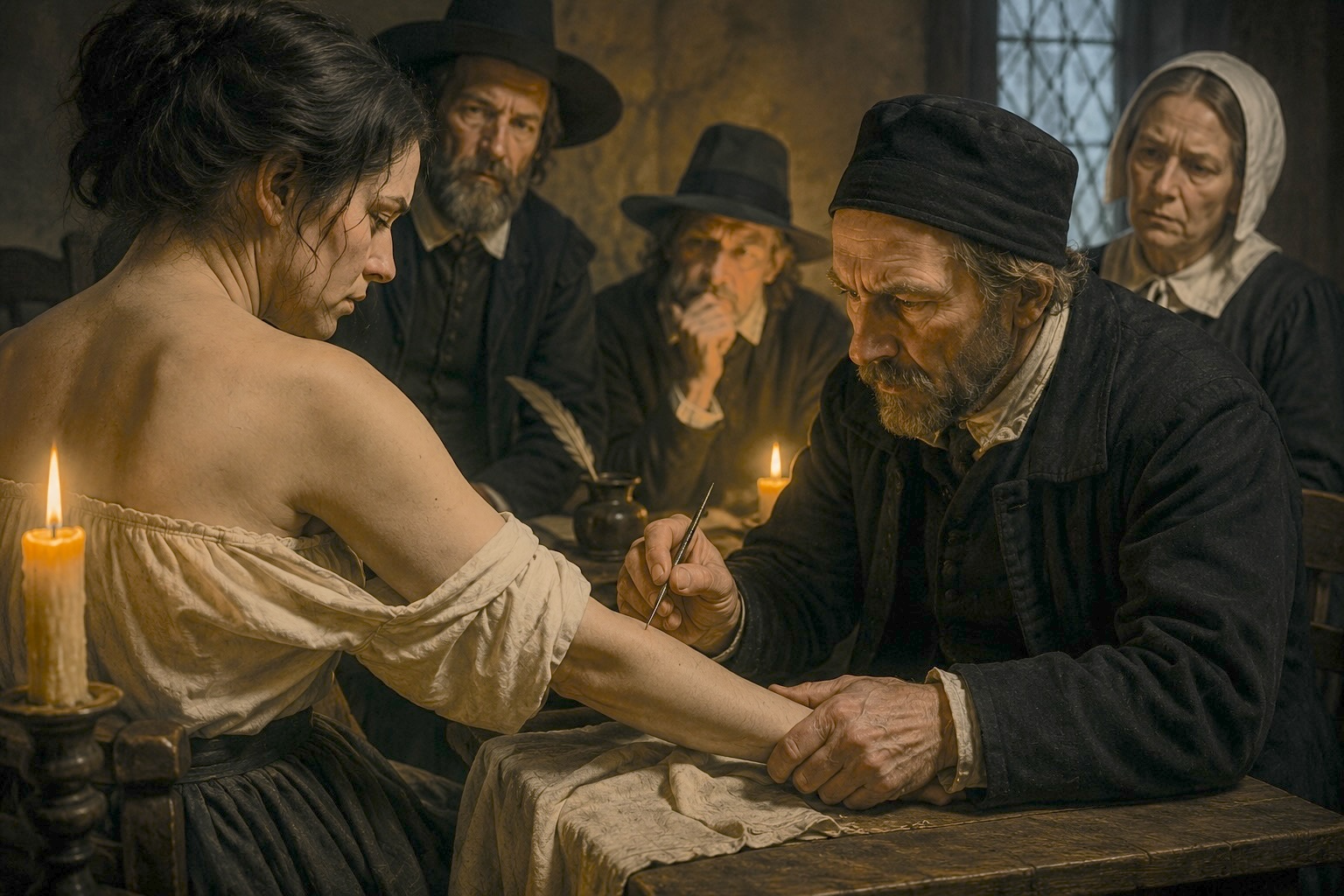
Imagine being accused of witchcraft.
Now imagine being stripped of your clothing while strangers examine every inch of your body.
They may search your hair or remove it. Every mole, scar, wart, birthmark, freckle, skin tag, and unusual patch of skin suddenly seems suspicious. Then comes the needle.
Your skin is repeatedly pierced while someone searches for one particular place on your body—a place believed incapable of bleeding and of feeling pain.
If they find it, they may declare that they have discovered the Devil’s mark.
And in seventeenth-century Scotland, that discovery could help send an accused person toward imprisonment, trial, and possibly death.
Among the many disturbing figures who emerged during Europe’s witch persecutions were people commonly remembered today as witch pickers, though the historical Scottish term was more often witch-prickers.
Some became professionals, traveling from community to community and being paid to identify supposed witches.
They did not hunt for broomsticks or cottages with bubbling cauldrons; they searched the human body.
And sometimes, they were paid when they found what everyone feared was there.
Witch Pickers, Witch-Prickers, and Searchers
Before going further, there is an important distinction to make.
The terms witch picker, witch-pricker, witch-finder, and searcher are sometimes used interchangeably today, but historically they could describe different roles.
A witch-pricker used pins, needles, or bodkins to search an accused person’s body for an insensitive place believed to be the Devil’s mark.
A searcher physically examined the body for suspicious marks, blemishes, or other supposed signs of witchcraft. Searching did not necessarily involve pricking.
A witch-finder was a broader term for someone involved in identifying suspected witches and could employ several methods.
In Scotland, pricking became sufficiently established that professional itinerant witch-prickers appeared.
The University of Edinburgh’s Survey of Scottish Witchcraft, which documents 3,837 known people accused of witchcraft in Scotland, notes that approximately ten professional witch-prickers are known to have operated there.
That number may sound small, but their influence was not.
The Devil’s Mark
Why would anyone believe that sticking a needle into someone’s skin could prove witchcraft?
The answer lies within early modern Christian demonology.
Many authorities believed that a witch entered a pact with the Devil. According to this belief, the Devil could place a mark upon his followers at the time of their pact—a sinister imitation or parody of Christian baptism.
The mark might appear as an ordinary blemish: a mole, wart, scar, birthmark, or other irregularity.
But sometimes the Devil’s mark was believed to be invisible.
What supposedly distinguished it was its lack of normal sensation.
The Survey of Scottish Witchcraft explains that investigators searched for either a visible bodily blemish or an insensitive spot.
They could discover the insensitive area by repeatedly pricking the accused with pins.
Think about what that meant in practice.
The human body is filled with variations. Scar tissue may have reduced sensitivity. Skin thickness varies. Some areas bleed more readily than others. Nerve sensation is not identical everywhere.
Yet in a culture already convinced that witches existed, normal variations of the human body could be interpreted through a supernatural lens.
A scar was no longer simply a scar; a mole was no longer simply a mole; and a numb patch of skin could become evidence of a covenant with Satan.
The body itself had become a crime scene.
The Search
For the accused, the process could be deeply humiliating and painful.
Investigators wanted access to the body because the supposed mark could be hidden anywhere. The examination therefore required far more than looking at someone’s hands or face.
The accused might be stripped and closely examined for suspicious marks before or during pricking.
This aspect of witch persecution is particularly important because most of those accused in Scotland were women.
Of the named accused whose sex is known in the Scottish database, the overwhelming majority were female.
The search for the Devil’s mark therefore placed women’s bodies under the authority and scrutiny of institutions attempting to prove a supernatural crime.
And the logic of the examination created a terrible problem: everyone has marks.
Nearly every human being has scars, freckles, moles, discolorations, calluses, or areas of skin that look different from the surrounding tissue.
If an investigator expected to find something unusual, the human body offered almost endless possibilities.
John Kincaid: Scotland’s Notorious Witch-Pricker
One name appears repeatedly in Scotland’s witch-pricking records, that of John Kincaid.
Kincaid was associated with Tranent in East Lothian and became one of Scotland’s best-known professional witch-prickers.
The surviving Scottish database records him as a witch-pricker or investigator in numerous cases between 1649 and 1661.
His career coincided with periods of intense Scottish witch persecution.
Scotland’s Witchcraft Act had been in force since 1563, and accusations did not occur at a steady rate.
Instead, prosecutions surged during several major periods, particularly 1590–91, 1597, 1628–30, 1649, and 1661–62.
Kincaid was active during two of those great waves.
His job was to find the mark.
Historical records associate him with accused people including Patrick Watson, Manie Halieburton, Bessie Mortoun, Marion Inglis, Issobell Fergussone, Christiane Wilsone, Bessie Moffat, Beatrix Leslie, Elspet Graham, Kathrin Huntar, and Janet Paistoun.
And Kincaid was paid for his work.
Records from Fife show a payment of twenty merks to Kincaid for coming to test Bessie Mortoun for the witch mark. Another surviving account records him receiving £6 Scots for “brodding” Margaret Dunhome, with additional expenses associated with his visit.
That detail changes the story; witch-pricking was not simply something frightened neighbors improvised, for certain men, it became employment.
When Finding Witches Becomes a Business
An uncomfortable question hides inside the practice.
What happens when someone earns money by finding witches?
A witch-pricker who repeatedly announced that no witch could be found might soon find himself unnecessary.
But a pricker who discovered marks could establish a reputation; other communities might summon him.
More accused people could be examined; thereby, more money could be earned.
This does not mean that every professional pricker consciously fabricated evidence.
Some undoubtedly operated within a worldview in which they sincerely believed that witches and Devil’s marks existed.
But financial incentive and deeply held belief are not mutually exclusive.
Eventually, Scottish authorities themselves began questioning the reliability of the practice.
The Needle That Lied
One of the most enduring stories surrounding witch-pricking concerns deceptive needles.
Later accounts describe prickers using specially constructed instruments in which the needle could retract into the handle when pressed against the skin.
To observers, it would appear that the needle had penetrated deeply; in reality, it had not entered the body at all.
The accused naturally felt no pain; there was no blood; and the pricker could announce triumphantly that the Devil’s mark had been found.
The historical record does show growing accusations of fraud and malpractice against professional prickers, although we should be cautious about assuming that every witch-pricker used a retractable needle or that every surviving case involved deliberate deception.
What we can say with confidence is that authorities eventually became deeply suspicious of professional pricking, and John Kincaid himself would experience that change.
The Witch-Pricker Becomes the Suspect
By 1662, Kincaid’s profession had begun attracting official scrutiny.
On 31 March 1662, he was imprisoned in Edinburgh’s Tolbooth on suspicion of malpractice.
A few days later, a justice depute questioned him about his methods.
A modern edition of Scottish witchcraft trial records describes Kincaid as the most active known Scottish witch-pricker and preserves the remarkable spectacle of the professional witch-finder being required to defend his own practices before a skeptical judicial authority.
The irony is difficult to miss.
For years, Kincaid had examined other people’s bodies looking for evidence that could be used against them; now authorities were examining him.
The Survey of Scottish Witchcraft notes that skepticism toward evidence obtained through torture and pricking increased after the disastrous witch-hunting panic of 1661–62.
Pricking for the Devil’s mark increasingly came to be regarded as fraudulent.
But Kincaid was not the only professional whose activities raised troubling questions; another case is even stranger.
Christian Cauldwell: The Woman Who Became “John Dickson”
In 1662, Scottish authorities arrested someone they knew as John Dickson, a professional witch-pricker who had been operating in northern Scotland.
But John Dickson was not who authorities believed “he” was.
The person was recorded as Christian Cauldwell, also rendered Caddell or Caldwell, a woman who had dressed as a man and worked professionally as a witch-pricker; her story is extraordinary.
According to records preserved in the Survey of Scottish Witchcraft, Cauldwell presented herself as a burgess from Forfar and entered into a contract with officials in Moray to serve as their witch-pricker for one year.
And we know something remarkable about her payment arrangement; she received six shillings per day—and £6 for every witch found guilty; read that again.
She had a financial interest tied directly to conviction.
Cauldwell traveled through areas including Elgin, Forres, Nairn, Inverness, Ross, and Sutherland, pricking people accused of witchcraft.
She worked with a woman named Issobell Dick and claimed that she had learned her skill by observing none other than John Kincaid.
She even claimed she could recognize witches simply by looking into their eyes.
Eventually her activities attracted the attention of authorities.
She was held in Edinburgh’s Tolbooth on 30 August 1662 and interrogated by the justice deputes.
The surviving indictment accused her of acting as a witch-pricker and pricking many of the king’s subjects throughout northern Scotland.
The person who had built a livelihood identifying witches had herself fallen under suspicion.
Could Anyone Pass the Test?
Perhaps the most terrifying aspect of witch-pricking was that innocence offered no reliable protection.
Imagine being the accused; you know that you have never entered into a pact with the Devil; you know that the mole on your shoulder has been there since childhood; you know that the scar on your hand came from an accident.
But the people examining you already believe that the Devil leaves marks.
Now someone begins piercing your skin repeatedly; how many times must they prick before you react incorrectly?
How much pain can you endure before exhaustion changes your response?
What happens if scar tissue does not hurt as expected; what happens if one puncture fails to bleed; and what happens if the person holding the needle has already decided what he expects to find?
There was no scientific control; no medical understanding of nerve distribution comparable to our own; no independent laboratory; and there was certainly no presumption that an unusual physical response had a perfectly ordinary biological explanation.
The test was built on a belief that shaped how the result was interpreted.
Not Every Witch Trial Used Pricking
It is also important not to give witch-pricking more prominence than the historical evidence supports.
Not every person accused of witchcraft was pricked; not every Scottish witch trial involved a professional pricker; and pricking was only one part of a much larger system of accusation and prosecution.
The Survey of Scottish Witchcraft identifies four particularly important forms of evidence used in Scottish witchcraft cases: confessions, neighbors’ testimony, accusations from other suspected witches, and the Devil’s mark.
Often, accusations began within communities.
A quarrel occurred; a neighbor became ill; livestock died; a child suffered seizures; a crop failed; or someone remembered an angry word spoken days or months earlier.
Suspicion developed.
Once a person had acquired a reputation for witchcraft, almost any misfortune could reinforce it.
The witch-pricker often entered a story that had already begun.
His needle did not necessarily create the accusation; but it could give supernatural suspicion the appearance of physical evidence.
When the Authorities Began to Doubt
By the later seventeenth century, the intellectual and legal foundations supporting witch prosecution were beginning to weaken.
Lawyers and officials increasingly questioned whether confessions obtained through torture could be trusted; they questioned whether supposed supernatural evidence could actually prove guilt; and professional witch-prickers became increasingly associated with deception, cruelty, and unreliable evidence.
The Scottish authorities’ reaction to the excesses of 1661–62 was particularly important. Procedures were tightened, and professional pricking increasingly lost credibility.
Witchcraft prosecutions did not immediately disappear.
But something had changed.
The needle that had once supposedly revealed Satan’s secret mark was becoming evidence of something else entirely: human credulity, institutional failure, and the terrible consequences of allowing belief to masquerade as proof.
The Body as Evidence
Perhaps that is what makes the history of witch-pricking so disturbing; it reminds us that the witch trials were not only about strange beliefs, frightened villagers, or dramatic courtroom accusations.
They were also intensely physical: real bodies were imprisoned, deprived of sleep, searched, pierced, and forced to stand while strangers interpreted ordinary features of their bodies as evidence of an impossible crime.
For many accused women, their bodies ceased to belong entirely to them the moment suspicion took hold.
A birthmark could become Satan’s seal; a mole could become evidence of a demonic covenant; or a scar could acquire a history it never possessed.
The accused did not have to carry proof of witchcraft upon her body; someone merely had to believe that she did, and then someone else had to find it.
What the Witch-Prickers Really Found
John Kincaid and the other witch-prickers believed—or claimed—that their needles could reveal witches, but four centuries later, their story reveals something very different.
It shows us what happens when a society decides what the evidence must mean before examining the evidence itself.
The witch-pricker approached the accused expecting the Devil to have left a mark.
Therefore, a mark became evidence; if the mark hurt, another place could be tested; if it bled, another blemish could be examined; and if the accused cried out, the search continued.
Eventually, somewhere upon an imperfect human body, something might appear unusual enough to satisfy the expectation.
And once that happened, the needle had supposedly spoken.
But needles do not identify witches; people do; the courts do; communities do; and/or belief does.
Perhaps the darkest lesson of the witch-pricker is not that people once believed the Devil marked witches; it is that once a society becomes convinced that a particular group is dangerous, it can begin searching for physical proof of something it has already decided must exist.
Sooner or later, someone will claim to have found it.
A Question for My Fellow Seekers
Imagine living in seventeenth-century Scotland and discovering that a professional witch-pricker has arrived in your village.
Someone has whispered your name.
Perhaps you are a healer; perhaps you are outspoken; perhaps you argued with a neighbor whose child later became sick; or perhaps you are simply different.
Now your body is about to be searched for evidence of witchcraft.
Do you think there was anything an accused person could have said or done to prove their innocence once the community had decided to see them as a witch?
I would love to hear your thoughts in the comments.
Sources & Further Exploration
For readers who would like to explore the historical records themselves, the University of Edinburgh’s Survey of Scottish Witchcraft, 1563–1736 is one of the most valuable resources available.
Created by Julian Goodare, Louise Yeoman, Lauren Martin, and Joyce Miller, its database contains information on 3,837 known Scottish witchcraft accusations and allows researchers to explore accused people, trials, investigators, beliefs, and prosecution practices.
The Survey’s recommended scholarship on witch-pricking includes W. N. Neill’s The Professional Pricker and His Test for Witchcraft and S. W. MacDonald’s The Devil’s Mark and the Witch-Prickers of Scotland.
For researchers interested in the surviving legal records themselves, the National Records of Scotland notes that Scottish witchcraft proceedings survive among records of the High Court of Justiciary, Privy Council, and local kirk sessions.
Don’t be Shy. Leave a Reply! Your comments, thoughts and suggestions for new posts are welcome.