
Pagan Symbols That Found a Home in Christian Churches
“Walk into an ancient cathedral, and you may be surrounded by symbols far older than Christianity itself.”
For centuries, churches have been viewed as the ultimate symbols of Christian faith. Their soaring spires reach toward heaven, stained-glass windows tell biblical stories, and carved stone saints watch silently over worshippers.
Yet beneath the familiar crosses and scriptures lies another story—one written in leaves and vines, carved into stone circles, whispered through sacred geometry, and preserved in symbols that predate Christianity by centuries, and in some cases, millennia.
This is not a story of conspiracy.
It is a story of history.
It is the story of how one religion inherited, adapted, and transformed elements of the cultures that came before it.
When Worlds Collided
As Christianity spread across Europe, it encountered societies with deeply rooted spiritual traditions.
The Celts honored sacred groves.
The Romans revered household gods and solar festivals.
The Norse worshipped among ancient forests.
The Greeks celebrated deities whose temples had stood for centuries.
Conversion rarely happened overnight.
Rather than erasing every existing tradition, Christian missionaries and local communities often reinterpreted familiar places, customs, and symbols through a Christian lens. This gradual blending of religious traditions is known as syncretism, and historians regard it as a common feature of religious change throughout history.
Many of the symbols we now associate with Christianity have histories that stretch far beyond the Church itself.

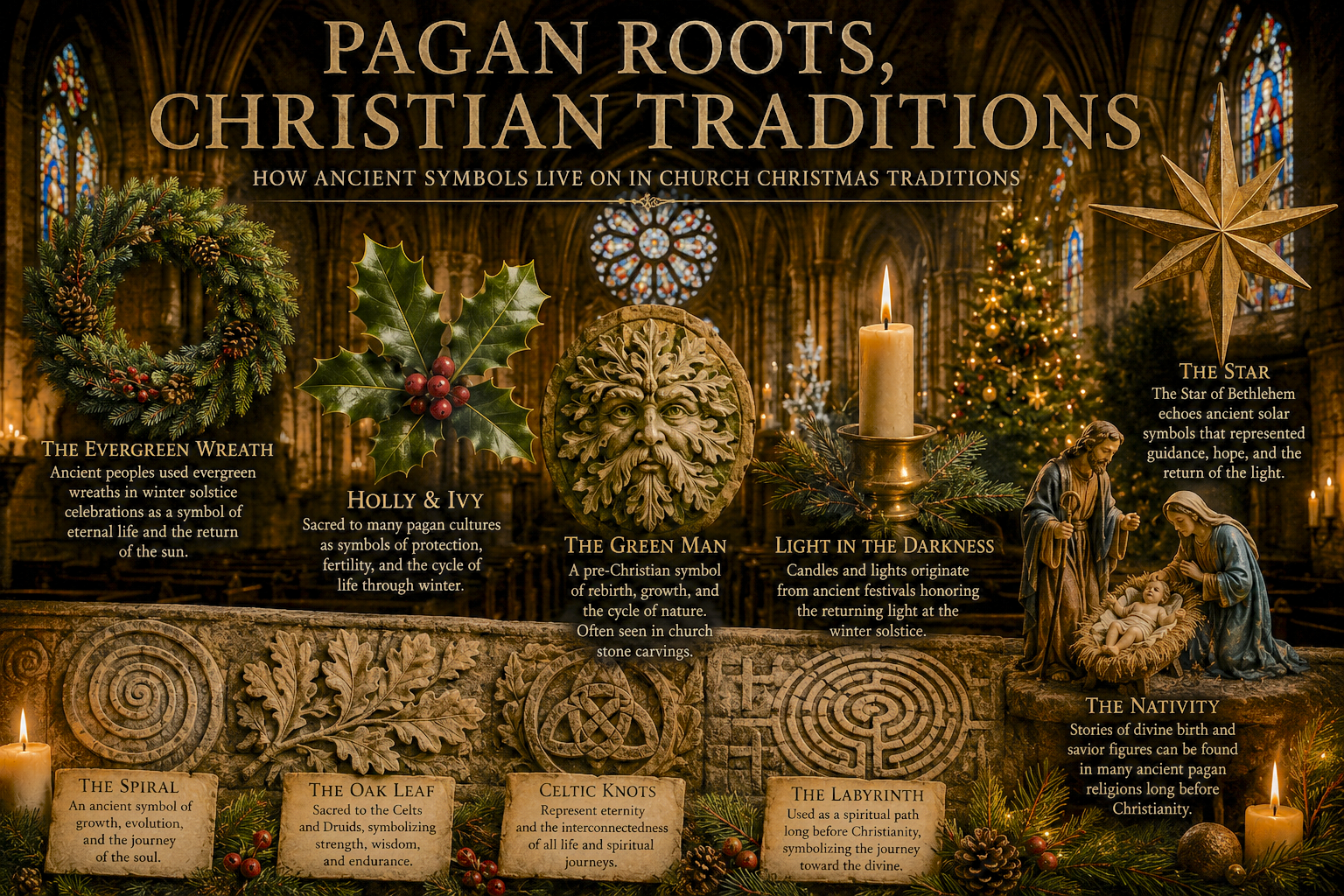
The Evergreen Tree
Long before Christmas trees appeared in homes, evergreen branches symbolized life during the darkest days of winter.
Across northern Europe, evergreen plants represented endurance, renewal, and the promise that spring would return.
Early Christians embraced this powerful imagery, giving it new meaning through the celebration of Christ’s birth.
The symbol remained.
Its interpretation changed.
The Holly and the Ivy
In pre-Christian Europe, holly and ivy were associated with protection, fertility, and the changing seasons.
Christian tradition later connected holly’s sharp leaves to Christ’s crown of thorns and its red berries to His sacrifice.
The plant did not change.
Its story did.
The Green Man
Perhaps no figure surprises visitors to medieval churches more than the Green Man.
His face peers from carved capitals, choir stalls, archways, and doorways.
Leaves burst from his mouth.
Branches grow from his beard.
He appears in hundreds of churches throughout Britain and Europe.
Scholars continue to debate his meaning.
Some believe he represents nature’s endless cycle of death and rebirth, echoing pre-Christian beliefs about fertility and renewal.
Others argue that medieval craftsmen used popular decorative motifs without assigning them deep religious significance.
Whatever his original purpose, the Green Man remains one of the most fascinating examples of a symbol that bridges pagan and Christian worlds.
Sacred Wells
Long before churches were built beside them, natural springs were places of healing and spiritual devotion.
Ancient peoples believed certain waters possessed sacred powers.
Rather than abandoning these revered locations, many Christian communities dedicated them to saints.
Pilgrims continued to visit the same waters.
Only the prayers changed.
Circles, Spirals, and Sacred Geometry
The circle has long symbolized eternity, the cosmos, and the cycles of nature.
Spirals represented growth, transformation, and life’s continual unfolding.
These ancient motifs appear in prehistoric monuments, Celtic art, and Roman mosaics.
They also appear in medieval churches, illuminated manuscripts, and cathedral floors.
Whether employed for symbolic, artistic, or theological reasons, these timeless geometric forms connected Christian builders with a visual language already familiar to the communities they served.
The Labyrinth
One of the most remarkable features found in several medieval cathedrals is the labyrinth.
Unlike a maze, a labyrinth contains a single winding path leading toward the center before returning again.
Although labyrinths existed long before Christianity, medieval Christians adopted them as symbolic pilgrimages representing the soul’s spiritual journey toward God.
Today they continue to invite quiet reflection, much as they have for centuries.
The Oak
Among Celtic and Germanic peoples, the oak represented strength, wisdom, and endurance.
It was closely associated with sacred groves and religious ceremony.
Although Christianity discouraged the worship of sacred trees, the symbolism of the oak endured in Christian art, architecture, and literature, where it came to represent steadfast faith and divine strength.
The Wheel of the Year
Perhaps one of the most debated topics among historians concerns the relationship between Christian feast days and earlier seasonal festivals.
Many major Christian celebrations occur near older agricultural or religious observances.
Christmas falls near the winter solstice.
Easter coincides with spring festivals celebrating renewal.
While scholars continue to debate the extent of direct borrowing in individual cases, most agree that Christianity developed within societies already structured around seasonal calendars and agricultural rhythms.
The calendar itself became a meeting place between old traditions and new beliefs.

History Is More Complex Than Either Side Claims
Discussions about pagan influences in Christianity often become polarized.
Some insist that Christianity erased every trace of pagan religion.
Others claim nearly every Christian tradition is pagan in origin.
History tells a more nuanced story.
Religions evolve.
Cultures influence one another.
Symbols gain new meanings while retaining echoes of their earlier lives.
The people who built Europe’s churches did not live in separate worlds divided neatly between “pagan” and “Christian.”
They lived through generations of transition, where old customs and new beliefs frequently existed side by side.
Why This Matters
Understanding these shared symbols does not diminish either pagan traditions or Christianity.
Instead, it reveals something deeply human.
Across cultures and across centuries, people have searched for meaning in the changing seasons, the rising sun, flowing water, sacred trees, and the endless cycles of life.
Perhaps that is why these ancient symbols continue to speak to us today.
They remind us that history is rarely about replacement.
More often, it is about transformation.
🔍 The Historian’s Corner
Well Supported by Historical Evidence
- The adaptation of sacred wells into Christian pilgrimage sites.
- The widespread use of the Green Man in medieval church architecture.
- The incorporation of evergreen symbolism into Christmas traditions.
- The process of religious syncretism during the Christianization of Europe.
Still Debated
- The precise origins and intended meaning of the Green Man.
- The extent to which individual Christian festivals directly replaced specific pagan festivals.
- Whether certain decorative motifs retained pagan religious significance or became purely artistic.
A Note from the Author
History is often richer than the myths we inherit. The story of Christianity and Europe’s older spiritual traditions is not one of simple replacement but of centuries of adaptation, reinterpretation, and cultural exchange. By exploring both the evidence and the ongoing scholarly debates, we gain a deeper appreciation for the people who lived through these remarkable transformations.
Further Reading
- Ronald Hutton, The Stations of the Sun: A History of the Ritual Year in Britain. https://archive.org/details/stationsofsunhis0000hutt
- Ronald Hutton, The Pagan Religions of the Ancient British Isles. https://archive.org/details/isbn_9780631172888
- Miranda Green, Symbol and Image in Celtic Religious Art. https://archive.org/details/symbolimageincel0000aldh
- Richard Hayman, The Green Man. https://openlibrary.org/books/OL24793925M/The_Green_Man
- Eamon Duffy, The Stripping of the Altars: Traditional Religion in England, c. 1400–1580. https://archive.org/details/strippingofalta00duff
Don’t be Shy. Leave a Reply! Your comments, thoughts and suggestions for new posts are welcome.