


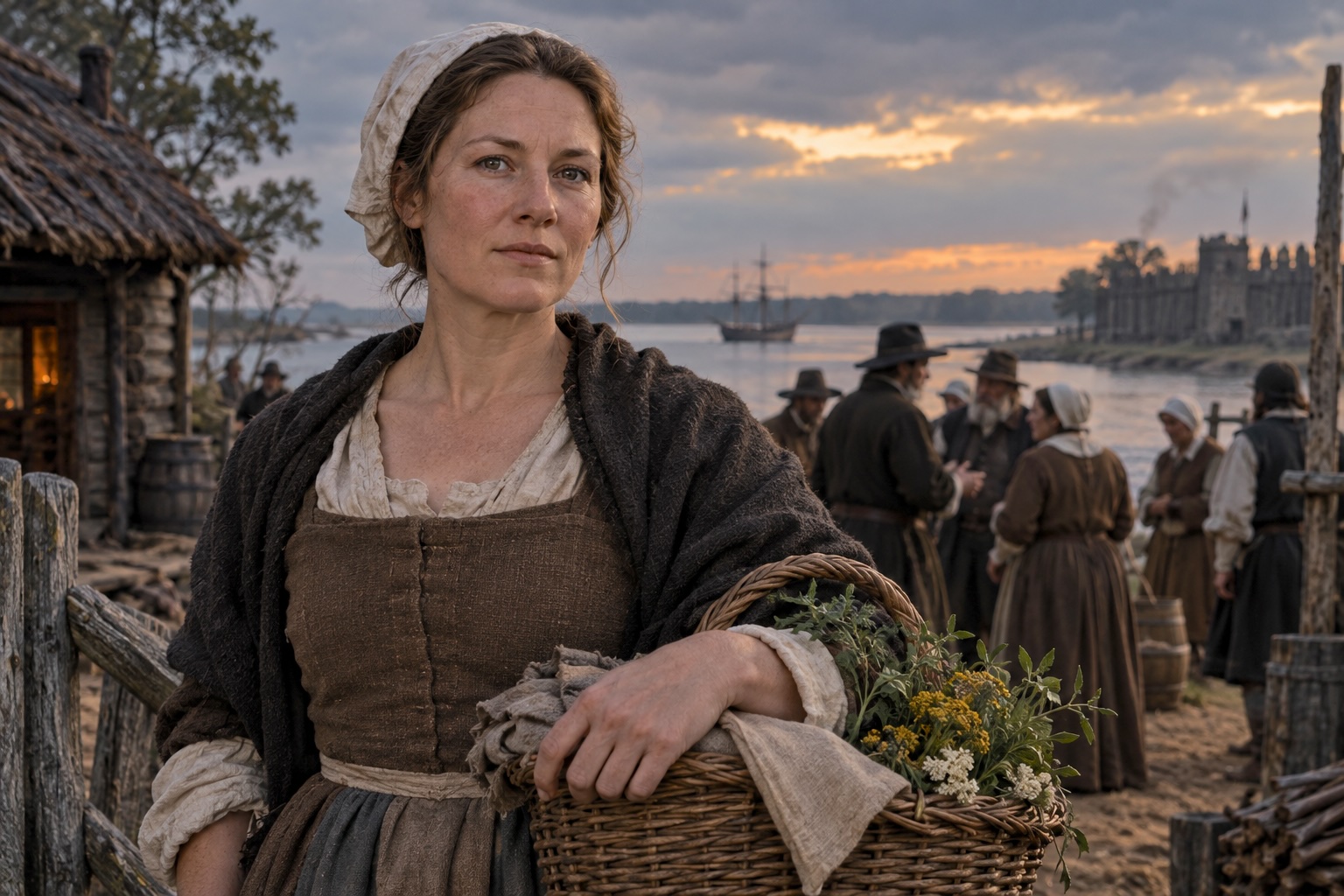
Before Salem. Before the Massachusetts witch panic. Before the names Tituba, Sarah Good, Bridget Bishop, or Rebecca Nurse entered American history, there was Joan Wright.
On September 11, 1626, a group of men and women gathered before Virginia’s General Court at Jamestown and began telling stories about a woman they called Goodwife Wright.
Her name was Joan.
She was a wife. A mother. A midwife. A woman who appears to have possessed knowledge of traditional folk practices. She was also left-handed.
And nearly four centuries ago, those ordinary and extraordinary pieces of her identity became part of a case accusing her of witchcraft.
Joan Wright’s case is generally regarded as the earliest documented legal accusation of witchcraft against an English settler in British North America. The accusation came sixty-six years before the Salem witch trials of 1692 and decades before the witchcraft prosecutions most Americans associate with colonial history.
Yet Joan’s name is barely remembered.
Perhaps it is time we changed that.
Because when we strip away the word witch and read what remains in the surviving testimony, another woman begins to emerge: a woman living in a precarious colony where childbirth was dangerous, disease was commonplace, crops failed, animals died, neighbors quarreled, and inexplicable tragedy demanded an explanation.
Joan Wright became one of those explanations.
Before She Was a “Witch,” She Was Joan
Much about Joan’s early life remains uncertain.
Some later accounts identify her as Joan or Jane Wright and suggest that she was born around 1596. The surviving 1626 testimony more securely establishes that Joan had previously lived in Hull, England, before making her life in Virginia.
She was married to a man named Robert Wright. When Robert appeared before the General Court in 1626, he testified that they had been married for sixteen years, placing their marriage around 1610.
By the 1620s, Joan and Robert were living in Virginia. Records and historical accounts associate them with Elizabeth City and Kecoughtan—an early settlement in the area of present-day Hampton—and later with the region that became Surry County. The Hampton History Museum describes Joan as living in Elizabeth City with Robert and their two children.
Most importantly for understanding what happened to her, Joan was known as a midwife.
That meant people trusted her with one of the most intimate, dangerous and mysterious events of seventeenth-century life: childbirth.
There were no antibiotics. There were no modern obstetric units, ultrasounds or emergency Cesarean sections. Infection, hemorrhage and complications could turn childbirth into tragedy with terrifying speed.
The midwife stood in the middle of all of it.
She brought knowledge and experience into bedrooms of pregnant women where men often did not.
She touched women’s bodies, witnessed births and deaths, knew remedies, understood herbs, and observed aspects of the human body that many others did not.
That knowledge could make a woman indispensable; it could also make her frightening.
And Joan Wright was apparently a woman people already believed knew things others did not.
The Midwife Who Was Left-Handed
The event that appears to have helped ignite the accusations against Joan began with childbirth.
Lieutenant Giles Allington testified that he had originally asked Joan Wright to attend his wife during her delivery. But according to his testimony, Mrs. Allington did not want Joan to deliver her baby because Joan was left-handed.
They chose another midwife, Mrs. Grave, instead.
Joan apparently left the Allington household unhappy about being rejected.
Then things began to go wrong.
Mrs. Allington developed a serious breast infection or abscess after giving birth and remained ill for four or five weeks. Lieutenant Allington himself became sick for approximately three weeks.
Then their baby became ill.
The child was sick for two months, recovered for about a month, became extremely ill again for another five weeks, and died.
To us, the sequence is heartbreaking but medically imaginable.
To people living in 1626, however, tragedy could have another explanation.
Someone might have caused it.
And there was Joan—the rejected midwife who had left their house displeased.
The circumstances were enough to transform coincidence into suspicion.
One Misfortune Became Another
Once suspicion attached itself to Joan Wright, neighbors began remembering other strange things.
Lieutenant Allington recalled hearing that Sergeant Booth had somehow been “crossed” by a woman. For approximately a year afterward, Booth supposedly encountered perfectly good game while hunting but could not kill anything.
Allington admitted something significant: he could not say that the woman responsible was Joan Wright.
But her name was nevertheless now attached to the story.
Thomas Jones offered another version. According to him, Booth had said that Joan wanted something from him—possibly a piece of meat—which he either could not or would not give her. Afterward, although Booth encountered good opportunities while hunting, he supposedly could not kill anything.
We will see this pattern repeatedly in later witchcraft accusations.
A disagreement, a refusal, an angry word, then something bad happens.
Once a person has a reputation for being a witch, ordinary misfortune becomes evidence.
The Chickens—and a Prediction of Death
Another witness, Daniel Watkins, remembered an incident from earlier that year.
Robert Thresher had a couple of hens that he intended to send to a woman named Elizabeth Arundle. Joan reportedly asked why he was keeping the hens tied there because, she said, the woman he intended to send them to would be dead before the chickens reached her.
Whether Joan was making a supernatural prediction, repeating gossip, knew Elizabeth was ill, or simply made an observation that later appeared prophetic is impossible to know.
But once someone died after Joan had spoken about death, the words acquired a completely different meaning.
Other testimony followed the same pattern.
Rebecca Graye testified that Joan told her that a mark or “token” on her forehead indicated that she would bury her husband.
Graye also recalled Joan saying that Mr. Felgate would bury his wife.
According to the testimony, he did.
Joan supposedly predicted that Thomas Harris would bury the woman who was then his betrothed.
According to the testimony, that happened too.
Then another woman complained to Joan that she had a difficult husband; Joan reportedly told her to be content because she would soon bury him.
The court record adds the ominous observation: It came to pass.
But the record cannot answer an important question: How many predictions did Joan make that did not come true?
People remember the eerie prediction followed by death.
They rarely record the hundred predictions that amounted to nothing.
“I Can Tell You If I Would”
Perhaps one of the most fascinating glimpses of Joan comes from Alice Baylie’s testimony.
Alice asked Joan which spouse would die first—whether Alice would bury her husband or her husband would bury her.
Joan’s response suggests that she was painfully aware of what people were already saying about her.
She essentially told Alice that she could answer, but because people were speaking against her for saying such things, she would say no more.
That response fascinates me.
It sounds less like a woman recklessly proclaiming supernatural power and more like someone who realized that her words were becoming dangerous.
People were listening, remembering, and repeating.
And Joan knew it.
The Missing Firewood
Then came a dispute over something astonishingly mundane: firewood.
Isabell Perry testified that a piece of “light wood” disappeared from the fort, and Joan accused a servant girl belonging to Goodwife Gates of stealing it.
Goodwife Gates responded not simply by denying the accusation, but by accusing Joan of witchcraft.
According to Perry, Gates said Joan had already done “many bad things” at Kecoughtan.
Perry asked Joan why, if the accusations were false, she did not formally complain and clear her name.
Joan’s recorded answer is one of the few moments in which her personality seems to break through nearly four hundred years of silence: “God forgive them.”
And according to Perry, Joan “made light of it.”
Those three words may tell us more about Joan Wright than pages of accusations.
God forgive them.
Not a confession; not a plea; and not an invocation of Satan.
Perhaps exasperation, defiance, resignation, or perhaps the response of a woman who had already lived with gossip long enough to understand that defending herself would accomplish very little.
“I Will Make Her Dance Stark Naked”
Joan apparently had a sharp tongue, too.
And I think giving her back her humanity means letting her be complicated rather than turning her into a flawless victim.
She became angry about the missing firewood.
According to Perry, Joan threatened the servant girl and said that if the stolen wood were not returned, she would make the girl “dance stark naked.”
The following morning, the wood was found inside the fort.
Elizabeth Gates offered similar testimony, claiming Joan had threatened her servant and said she would make the girl dance naked and stand before a tree.
Was Joan threatening magical punishment?
Was she frightening a girl she believed had stolen from her?
Was it dark humor?
Was it a local expression whose full meaning has disappeared?
We cannot know, but in a community already inclined to believe Joan possessed unusual powers, the return of the wood must have looked suspiciously like proof.
“A Witch Amongst All Them at Kickotan”
The most damaging thing Joan possessed may not have been magical knowledge at all.
It may have been a reputation.
Isabell Perry testified that a woman named Dorethie Behethlem questioned why Perry even allowed Joan into her house.
Joan, she said, was considered a very bad woman and was “accompted a witch amongst all them at Kickotan.”
There it is, the community had already named her.
Once that happened, every dead chicken, sick child, failed crop, angry remark, and unfortunate coincidence could be fitted into the story people had already decided to tell about her.
Joan did not have to perform witchcraft; she only needed the reputation of someone who could.
But Joan Did Know Something About Witchcraft
Or rather, Joan knew the folk beliefs and counter-witchcraft practices of the world she grew up in.
This is where Joan Wright becomes even more fascinating.
The testimony suggests that she possessed knowledge of English folk practices associated with witchcraft and counter-magic.
While living in Hull, Joan said she had once been churning butter when a woman reputed to be a witch entered the house.
According to the testimony, Joan was once “Chirninge of butter” (churning butter) at Hull when a woman reputed to be a witch entered the house.
Joan acted “by directions from her dame”: she pushed the churn staff to the bottom, crossed her hands over it, and supposedly prevented the suspected witch from leaving.
Eventually the woman fell to her knees, begged forgiveness, and claimed her hand was trapped in the churn—even though Joan believed both of the woman’s hands were free.
When Joan lifted the churn staff, the woman could leave.
In the second story, Joan’s dame herself believed she had been bewitched and instructed Joan to heat a horseshoe red-hot and throw it into the dame’s urine when the suspected woman appeared.
As long as the iron remained hot, the suspected witch supposedly suffered pain in her heart.
When the iron cooled, the woman’s suffering stopped.
Joan reportedly affirmed that the story was true, but that didn’t necessarily make Joan the one with magical powers; the power would have been from her dame (or mistress of the house).
To modern readers, these accounts may sound like admissions of witchcraft.
But seventeenth-century folk belief was far more complicated.
There was an important conceptual difference between supposedly causing harm through witchcraft and using charms, rituals, prayers, objects, or traditional practices to protect against witchcraft.
Joan’s stories place her in a world where supernatural belief existed alongside Christianity rather than neatly outside it.
The woman accused of being a witch may once have believed she was helping protect another household from one.
And Then There Were the Crops
Robert Thresher reportedly had another story.
Joan asked him for some plants.
He apparently told her she could have some after he took what he needed for himself.
Joan left.
That night, heavy rain came; the plants were drowned.
Again, nature had behaved like nature.
But because Joan Wright had asked for the plants shortly before the rain came, the weather could become evidence of witchcraft.
A storm had acquired a suspect.
September 11, 1626
Eventually gossip became law, and on September 11, 1626, the General Court met at Jamestown.
Among those present were Governor Sir George Yeardley, Captain West, and Doctor Pott.
Witness after witness was sworn and examined.
They spoke about sickness, death, predictions, hunting, chickens, firewood, rain, folk magic, a dead baby, and Joan Wright.
The surviving record is remarkable because it lets us watch a witchcraft accusation being constructed piece by piece.
No single spectacular event drives it; instead, memories accumulate.
Someone remembers something Joan said; someone else remembers an argument; another person remembers an illness; while yet another remembers a death.
Then someone else remembers rain; while another remembers chickens.
Individually, they prove almost nothing.
Together, to people who already believed witchcraft was real, they could create a witch.
Her Husband Was Called Before the Court
Then Robert Wright was questioned; his testimony is wonderfully simple.
He told the court that he had been married to Joan for sixteen years and knew nothing about her concerning the crime of which she had been accused.
Think about that.
For sixteen years he had lived beside her; shared meals with her; crossed an ocean and built a life in Virginia with her.
Watched her work; watched her become a mother; watched her enter other women’s homes as a midwife; and when authorities asked whether he knew his wife to be guilty of witchcraft, Robert Wright simply said no.
Nearly four hundred years later, that small statement deserves to stand beside all the accusations made against her.
What Happened to Joan?
Here the historical record becomes frustrating.
The surviving General Court minutes do not give us a clear verdict or sentence following the testimony.
The Surry County Historical Society notes that no further record of the affair appears in the surviving General Court material.
Some modern historical references therefore describe Joan as having been acquitted, while other historians more cautiously point out that the surviving record simply ends without preserving the disposition of her case.
Encyclopedia Virginia characterizes the result as an acquittal, but the actual transcript published there contains the testimony rather than a surviving verdict.
There is no surviving evidence that Joan Wright was executed; no gallows at the end of the story that we know; and no pyre.
Instead, Joan simply disappears from the witchcraft record.
And perhaps that is why so few people know her name.
History tends to remember spectacular horror.
It is less good at remembering the woman who stood on its edge and then vanished.
Virginia Was Not Salem
Joan’s story also reminds us that witchcraft prosecution in colonial America was not exclusively a New England phenomenon.
Virginia operated under English witchcraft law, particularly the 1604 statute enacted during James I’s reign.
Witchcraft was legally punishable, and colonial Virginians certainly believed that harmful magic—or maleficium—could exist.
Yet Virginia’s experience with witchcraft accusations developed differently from the later mass prosecutions in New England.
Virginia had no equivalent of the Salem panic.
Accusations occurred, but courts could be skeptical, cases could collapse, and people who publicly called someone a witch sometimes found themselves facing accusations of slander.
That does not mean the accusations were harmless.
Being called a witch could destroy a woman’s reputation long before a court ever determined whether a crime had occurred.
Joan Wright knew that nearly four hundred years ago.
“I am exclaimed against for such things,” she essentially told Alice Baylie.
So, she would tell no more.
Was Joan Wright Really a Witch?
This is the question people inevitably ask; however, it may be the wrong question.
We cannot know exactly what Joan believed.
The surviving testimony strongly suggests that she knew traditional practices associated with witchcraft and counter-witchcraft.
She apparently believed—or at least claimed—that certain rituals could interfere with the actions of a witch.
She may have practiced folk healing, or she may have been what later generations would call a cunning woman or wise woman.
But none of that proves she killed a child through magic.
It does not prove she killed chickens, ruined crops, controlled the rain, or cursed a hunter’s gun.
What the record proves is something much more human.
Her neighbors believed she could.
And sometimes belief is enough to put a woman in danger.
The Woman Behind “Goodwife Wright”
One thing troubles me whenever I read witch-trial records: the accused woman often disappears beneath the accusations.
We learn what neighbors said she did.
We learn what ministers believed about her.
We learn what magistrates asked.
We learn what frightened communities imagined.
But the woman herself becomes almost invisible.
Joan Wright deserves better.
She was not born “Surry’s Witch”; she was Joan.
She had crossed the Atlantic and built a life in one of England’s struggling North American settlements.
She was married for at least sixteen years by the time she entered the historical record.
She had children and worked as a midwife.
Women depended upon knowledge like hers during childbirth.
She apparently carried memories and folk traditions from Hull, England, into Virginia.
She argued with neighbors.
She became angry.
She made predictions she probably should not have made.
She told strange stories; she may have enjoyed the mystery surrounding her; she may have deliberately frightened people.
She may simply have been a strong-minded woman with knowledge and a sharp tongue living in a society where those qualities could become dangerous.
We do not have to turn Joan into a saint to restore her humanity; in fact, doing so would erase her almost as surely as calling her a witch did.
She was allowed to be difficult or angry.
She was allowed to know old remedies and strange customs.
She was allowed to argue about stolen firewood.
She was allowed to be left-handed, make predictions, to be wrong, and to be a complicated human being.
None of those things made her responsible for a baby’s death.
Four Hundred Years Later, Say Her Name
September 11, 1626; almost four centuries ago, Joan Wright’s neighbors stood before a court in Jamestown and told the authorities what they believed about her.
Their voices survived; hers barely did, and that may be one of the cruelest things about the history of witchcraft persecution.
The archive frequently preserves the accusation more faithfully than it preserves the accused.
We know the terrible things people said Joan had done.
We know far less about what she loved; what frightened her; what made her laugh; or how she felt when she crossed the Atlantic.
Or what remedies she carried in her memory; or how many babies she safely helped bring into the world.
Did she miss Hull; did she ever understand how dangerous the whispers around her had become?
And we do not know when or where Joan Wright died.
But we know her name.
Joan Wright, a wife, mother, midwife, immigrant, neighbor.
A woman who knew old folk beliefs; whose left hand made another woman distrust her.
A woman whose words were remembered whenever someone died.
A woman blamed when illness came, when animals died, when crops failed, and when storms fell from the sky.
A woman brought before Virginia’s highest colonial court while her neighbors described her as a witch.
Years before Salem had its accused women, Virginia had Joan.
And when we remember her today, perhaps the most important thing we can do is something her accusers could not: Look beyond the witch and see the woman.
Her name was Joan Wright.
Nearly four hundred years later, let us give it back to her.
Sources & Further Reading
General Court of Virginia. General Court Hears Case on Witchcraft (1626). Transcript from H. R. McIlwaine, ed., Minutes of the Council and General Court of Colonial Virginia, 1622–1632, 1670–1676. Encyclopedia Virginia / Virginia Humanities. This is the most important source because it provides the surviving September 1626 testimony itself.
Encyclopedia Virginia. Witchcraft in Colonial Virginia. Virginia Humanities. Provides historical context for Virginia witchcraft prosecutions and the 1604 English witchcraft statute.
Surry County, Virginia Historical Society. Eve S. Gregory, Joan Wright, Surry’s Witch. January 22, 2019. Provides a concise local history of Wright and discusses the surviving court record.
Library of Virginia, The Uncommon Wealth. There Be Great Witches Among Them: Witchcraft and the Devil in Colonial Virginia. Provides broader context for witchcraft accusations and prosecutions in seventeenth-century Virginia.
Library of Virginia, The Uncommon Wealth. Good Witch or a Bad Witch?: The Grace Sherwood Trial and Pardon. Includes discussion of Wright as the earliest recorded Virginia witchcraft accusation and places her case within the later history of Virginia witchcraft proceedings.
Hampton History Museum. The Witching of the Virginia Midwife. Historical material connecting Wright with Elizabeth City/Kecoughtan and examining the changing position of midwives in colonial Virginia.
Don’t be Shy. Leave a Reply! Your comments, thoughts and suggestions for new posts are welcome.