


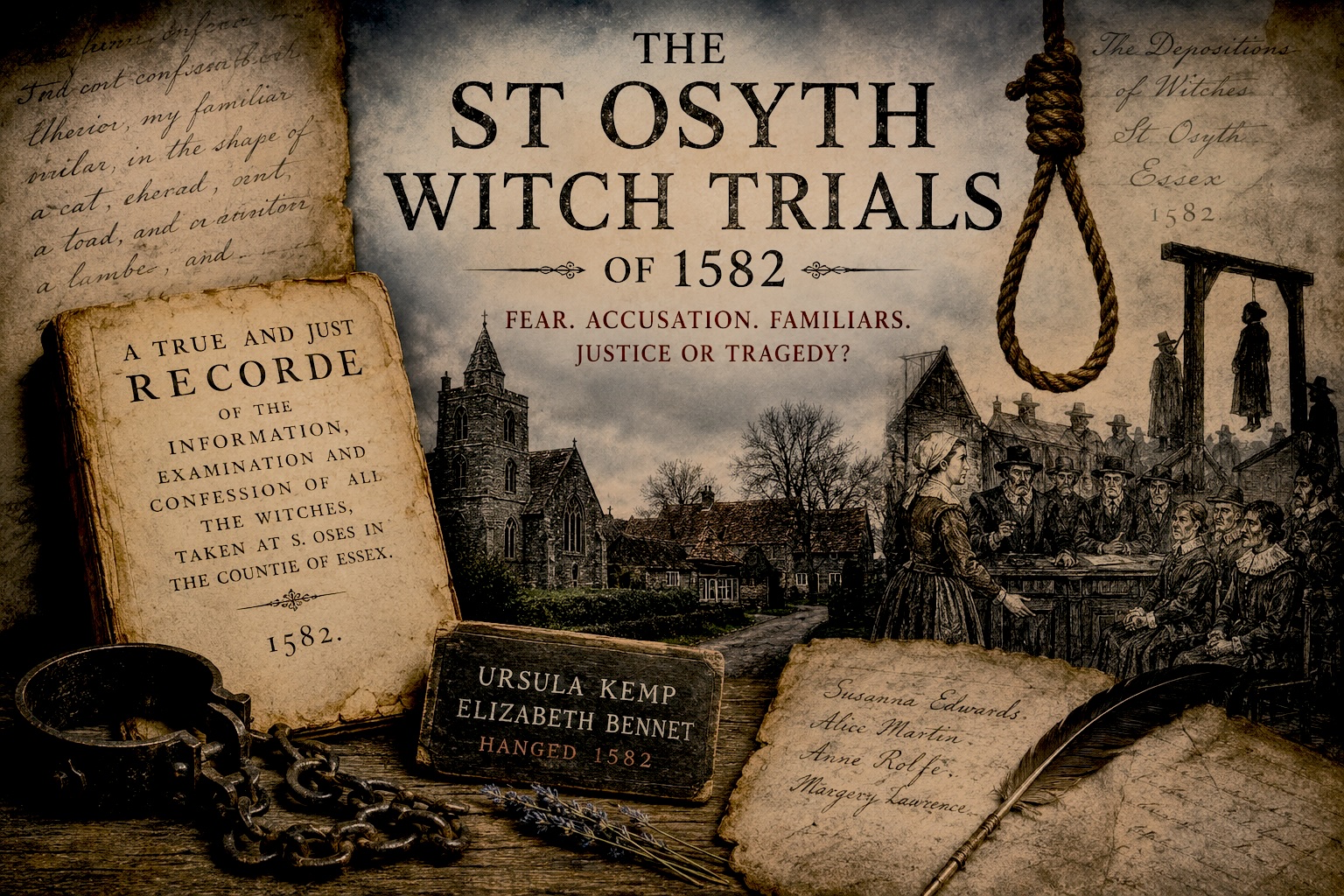
In February 1582, fear arrived in the Essex village of St Osyth.
It did not announce itself with a gathering of witches beneath a full moon, nor did anyone discover a secret coven practicing forbidden rites in the forest. Instead, as happened so often during the European witch persecutions, it began within the intimate world of neighbors, children, illnesses, quarrels, old resentments, and unexplained misfortune.
Within only a few weeks, accusations of witchcraft would spread beyond St Osyth into surrounding communities. Fifteen people would come under investigation. Women would accuse other women. Children would provide evidence against adults—including their own mothers. Strange animal familiars would appear throughout the testimony, and confessions would seem to confirm what terrified villagers already feared.
Before it was over, Ursula Kemp and Elizabeth Bennet would be hanged, others would die while imprisoned, and northeastern Essex would become the setting for one of the most remarkable witchcraft prosecutions of Elizabethan England.
Yet behind the stories of familiars, curses, and supposed magic lies something far more unsettling. These accusations arose among ordinary people who knew one another, and for the accused, the consequences were terrifyingly real.
England in the Age of Witchcraft
To understand what happened at St Osyth, we first have to enter the world of Elizabethan England.
Queen Elizabeth I had been on the throne for a little more than two decades when the accusations began. England was experiencing enormous religious, political, and social change, while belief in supernatural forces remained woven into everyday understandings of the world.
Magic was not necessarily something distant or fantastical. People sought remedies for illnesses, charms for protection, methods of divination, and assistance from individuals believed to possess unusual healing or magical abilities.
At the same time, witchcraft had become a matter of secular law. The Witchcraft Act of 1563 made certain forms of witchcraft punishable by death, particularly when supernatural harm was believed to have caused another person’s death.
This created a dangerous intersection between traditional supernatural beliefs and the machinery of the English legal system. If a child became mysteriously ill, livestock died, or someone suddenly suffered an unexplained death, witchcraft could provide an explanation.
And an explanation required someone to blame.
Ursula Kemp: Healer, Neighbor…Witch?
At the center of the St Osyth accusations was a woman whose name has survived for more than four centuries: Ursula Kemp, sometimes recorded as Ursley Kempe.
Ursula appears to have possessed knowledge of healing and nursing. Like many women later accused of witchcraft, the abilities that could make her valuable to her neighbors could also make her dangerous in their eyes.
One of those neighbors was Grace Thurlow.
According to the surviving account, Ursula had previously helped when Grace’s son was ill. Their relationship later deteriorated, however, and when further sickness and misfortune entered Grace’s household, suspicion began to settle upon Ursula.
This was how witchcraft accusations so often developed. They did not necessarily begin with evidence of secret magical practices but could emerge from an argument, an unexplained illness, the death of a child, a failed harvest, sick livestock, or a relationship that had soured.
When something terrible happened and no obvious explanation existed, fear searched for one.
And sometimes that explanation became a neighbor.
February 1582: The Accusations Begin
The St Osyth investigation unfolded with astonishing speed.
Historian Jonathan Durrant places the main period of investigation between February 19 and March 26, 1582. During those few weeks, fifteen suspected witches were investigated.
Once Ursula Kemp was accused and confessed, other accusations followed.
The panic also moved beyond St Osyth. Nearby communities including Little Oakley, Beaumont, Moze, Thorpe, Walton-le-Soken, and Little Clacton became entangled in the investigation.
This is why historians sometimes place quotation marks around the phrase “St Osyth witches.” The outbreak began there, but what followed was actually a much wider northeastern Essex witchcraft crisis.
At the center of the legal investigation stood local magistrate Brian Darcy.
Brian Darcy and the Search for Witches
Darcy has sometimes been portrayed as the driving force behind the witch hunt—a zealous magistrate determined to uncover witches wherever he could find them.
Modern scholarship paints a more complicated picture.
Historian Jonathan Durrant argues that Darcy did not simply manufacture a witch hunt from nothing. Rather, he responded to accusations already emerging from communities experiencing genuine fear, strained relationships, and a period of unusually high mortality.
That does not mean Darcy was skeptical. Far from it.
He appears to have accepted the possibility that witchcraft was real and took the accusations seriously. His examinations helped transform village suspicions into formal legal testimony.
But the St Osyth prosecutions cannot be explained by one powerful man alone. Accusers came forward because they believed something was happening. Neighbors already distrusted one another, and misfortune demanded explanations.
Once the machinery began moving, every new confession or accusation seemed to provide evidence that the previous accusations had been correct.
And then the familiars appeared.
Cats, Toads, Lambs, and Spirits
One of the most fascinating aspects of the St Osyth testimony is the extraordinary presence of familiars.
In English witchcraft belief, a familiar was a supernatural spirit believed to assist a witch. Unlike the dramatic demons we might imagine today, these spirits were frequently described as appearing in the forms of ordinary animals.
The testimony surrounding Ursula Kemp contained several: cats, a toad, and a lamb. These supposedly supernatural creatures were said to possess names and personalities and to perform harmful acts at the witch’s command.
To modern readers, these accounts can sound bizarre. But within the cultural world of sixteenth-century Essex, animal familiars provided something important: a way of explaining how a seemingly ordinary neighbor could supposedly perform extraordinary supernatural harm.
A woman did not need to fly through the night or openly cast spells. Her spirit could act for her.
And if an animal behaved strangely near the home of someone already suspected of witchcraft, imagination and fear could supply the rest.
When a Child Testified Against His Mother
Perhaps one of the most disturbing elements of Ursula Kemp’s story involves her own son.
During the investigation, testimony attributed to her young child was used against her. He described his mother’s supposed spirits and their animal forms, helping to reinforce the accusations already surrounding her.
It is difficult to read this testimony today without wondering what was happening to that child. What had he heard adults saying? What questions had been put to him? Was he frightened? Did he believe what he was saying? Did he understand what might happen to his mother because of his words?
Those questions cannot be answered with certainty.
But children’s testimony appears repeatedly throughout the history of witch trials, and it presents one of the most troubling problems for historians trying to understand these prosecutions.
Children lived within the same supernatural culture as adults. They heard stories about witches, devils, spirits, curses, and magical harm. At the same time, children were vulnerable to suggestion and pressure from authority figures.
Whatever produced the testimony in St Osyth, the consequences were devastating.
Confession and the Expanding Circle of Accusation
Once Ursula confessed, the investigation grew.
This pattern appears again and again in witch trials. An accusation leads to questioning. Questioning produces a confession. The confession produces names. Those names produce new examinations, which create new accusations.
Soon the existence of multiple accused witches appears to confirm that there must have been a larger conspiracy all along.
The circle widens.
What began as interpersonal conflict between neighbors becomes evidence of an invisible supernatural threat lurking throughout an entire community.
By the end of the St Osyth investigation, fifteen people had been investigated.
But not all suffered the same fate.
Ursula Kemp and Elizabeth Bennet
Two women are known to have been executed following the 1582 prosecutions: Ursula Kemp and Elizabeth Bennet.
They were hanged.
It is worth pausing here because centuries of folklore have a way of obscuring one important fact about English witch trials: English witches were generally not burned at the stake.
Witchcraft was prosecuted as a felony under English law, and those sentenced to death for it were normally executed by hanging. Burning was associated with other crimes and with witchcraft prosecutions elsewhere in Europe, but the familiar image of every accused witch dying amid flames does not accurately represent the English experience.
Ursula Kemp and Elizabeth Bennet died at the gallows.
And they were not the only casualties.
The Accused Who Died in Prison
Research by historian Professor Marion Gibson indicates that, in addition to the two known executions, at least four other accused people died while imprisoned.
Others remained incarcerated.
One woman connected with the prosecutions was not released until 1588—six years after the accusations began.
This part of witch-trial history is easily overlooked.
Execution records give us names and dates, making the gallows the dramatic endpoint of these stories. But early modern imprisonment could itself become a death sentence.
Prisons were frequently cold, filthy, overcrowded, and disease-ridden. Food and basic necessities could be inadequate, and prisoners might remain confined while waiting for legal proceedings or decisions that moved painfully slowly.
So when we count the victims of witch persecutions, we cannot look only at those formally executed.
Some died without ever reaching the gallows.
A True and Just Recorde
One reason we know so much about the St Osyth prosecutions is an extraordinary publication produced in the same year.
Its title begins:
A True and Just Recorde, of the Information, Examination and Confession of All the Witches, Taken at S. Oses in the Countie of Essex…
Published in 1582, the pamphlet preserved material relating to the examinations and accusations almost immediately after they occurred.
For historians, documents like this are invaluable.
But they must also be treated cautiously.
A printed witchcraft pamphlet was not a modern courtroom transcript, nor was it an objective newspaper report. Such publications existed within a literary and religious culture that already assumed witchcraft was possible and often presented cases in ways intended to instruct, warn, or fascinate readers.
Nevertheless, A True and Just Recorde gives us something remarkable. It allows us to hear echoes of a frightened Essex community more than four centuries later.
We encounter accusations between neighbors, descriptions of illness and death, supposed confessions, strange familiars, and the voices of people attempting to explain events they could not otherwise understand.
Were They Really Witches?
This is the question that inevitably follows almost every historical witch trial.
Were any of these women actually practicing witchcraft?
The answer depends upon what we mean by “witch.”
Some people accused of witchcraft in early modern Europe almost certainly practiced forms of folk magic, healing, divination, charm-making, or other traditions that their communities understood as supernatural.
Others probably practiced nothing remotely magical.
But the crime imagined by witch prosecutors was something much more sinister: deliberately causing supernatural harm through relationships with evil spirits.
There is no reliable evidence that Ursula Kemp or the other St Osyth accused possessed supernatural powers or committed the magical crimes attributed to them.
That does not mean the people accusing them were necessarily lying.
And this distinction is crucial.
Many accusers may have genuinely believed they were victims of witchcraft. If your worldview tells you that witches can cause illness, and your child becomes mysteriously sick shortly after you quarrel with a woman reputed to possess unusual powers, the connection may feel completely real.
The accusation can therefore be false while the fear behind it remains sincere.
That is one of the most unsettling lessons of witch-trial history.
People do not have to be deliberately cruel for terrible things to happen.
Sometimes they only have to be afraid.
Why St Osyth?
Recent scholarship suggests another important piece of the puzzle.
The accusations unfolded during a short-term mortality crisis in and around St Osyth.
People were dying. Communities were under stress, and personal relationships were fragile. Within such an atmosphere, deaths that might otherwise have been understood as unfortunate could begin to look suspicious—especially when they followed quarrels or threats.
The supernatural provided an explanation for chaos.
And once one suspected witch appeared, finding another became easier.
Then another.
And another.
This helps us understand why witchcraft accusations sometimes erupted in clusters rather than appearing evenly across time.
Fear can be contagious.
The Women Behind the Word “Witch”
This is the part of these stories that matters most to me.
When we read about historical witch trials, it is easy to become captivated by the imagery: familiars, spells, mysterious illnesses, confessions, curses, interrogations, haunted prisons, and ancient villages.
I understand that fascination because it is part of what draws me to this history too.
But somewhere along the way, we have to look beyond the word witch.
Ursula Kemp was a woman before she became “the St Osyth witch.”
Elizabeth Bennet was a person before history remembered her primarily for the accusation that led her to the gallows.
The others had families, neighbors, histories, arguments, friendships, reputations, fears, and ordinary lives.
Then someone accused them.
For some, everything that had come before was swallowed by that single word: witch.
More than four hundred years later, that is often the only reason we know their names.
From St Osyth to The Cage
Today, the memory of the trials has become deeply intertwined with The Cage, the historic village lock-up in St Osyth.
Local tradition has long associated the building with Ursula Kemp and the accused witches, although surviving documentary evidence does not prove that Ursula herself was imprisoned inside the building that stands today.
That distinction between documented history and folklore matters.
But so does the folklore.
The Cage has become a physical place upon which generations have attached the memory of 1582. Whether Ursula ever touched its walls or passed through its doorway, her story has become inseparable from it.
I explored that fascinating history—and the remarkable restoration of The Cage by its present Owners and Directors, Amy Waine and Jarrad Cutting of Amy’s Crypt—in my companion article on The Cage of St Osyth.
But when we strip away the haunted reputation and centuries of legend, we eventually return to the same place: a small Essex community in 1582 where neighbors became frightened of neighbors, children spoke against adults, women named other women, and a magistrate attempted to uncover what people believed was an invisible crime.
And ultimately, two women walked toward the gallows.
What St Osyth Leaves Behind
The St Osyth witch trials endure because they contain nearly every element we associate with the history of witchcraft: folk healing, familiars, accusations, confessions, frightened children, suspicious deaths, imprisonment, execution, and the gradual transformation of historical tragedy into folklore.
Yet perhaps their most important lesson has nothing supernatural about it.
The trials show us what can happen when fear becomes evidence and suspicion becomes certainty.
Once a community becomes convinced that an invisible enemy exists among them, ordinary events can suddenly acquire sinister meanings. Illness becomes a curse. An argument becomes motive. An animal becomes a familiar. A disliked neighbor becomes a witch.
And after that transformation occurs, proving innocence becomes almost impossible.
Ursula Kemp and Elizabeth Bennet have been dead for more than four centuries. The world that condemned them is gone.
Yet St Osyth remains, as does the memory of what happened there during those extraordinary weeks in 1582.
Perhaps that is the real reason we continue telling their stories.
Not because we should fear the witches of the past, but because we should remember what happened to the people accused of being them.
A Question for My Fellow Seekers
When you read historical accounts like the St Osyth trials, what fascinates—or disturbs—you most: the accusations of supernatural magic and familiars, or the very human relationships, fears, and grievances that existed beneath them?
And if you could recover one thing that has been lost from the historical record, what would you want to know about Ursula Kemp and the other accused women—not as “witches,” but as people?
Their accusers gave them the name witch. History gives us the opportunity to remember the human beings behind it.
Don’t be Shy. Leave a Reply! Your comments, thoughts and suggestions for new posts are welcome.