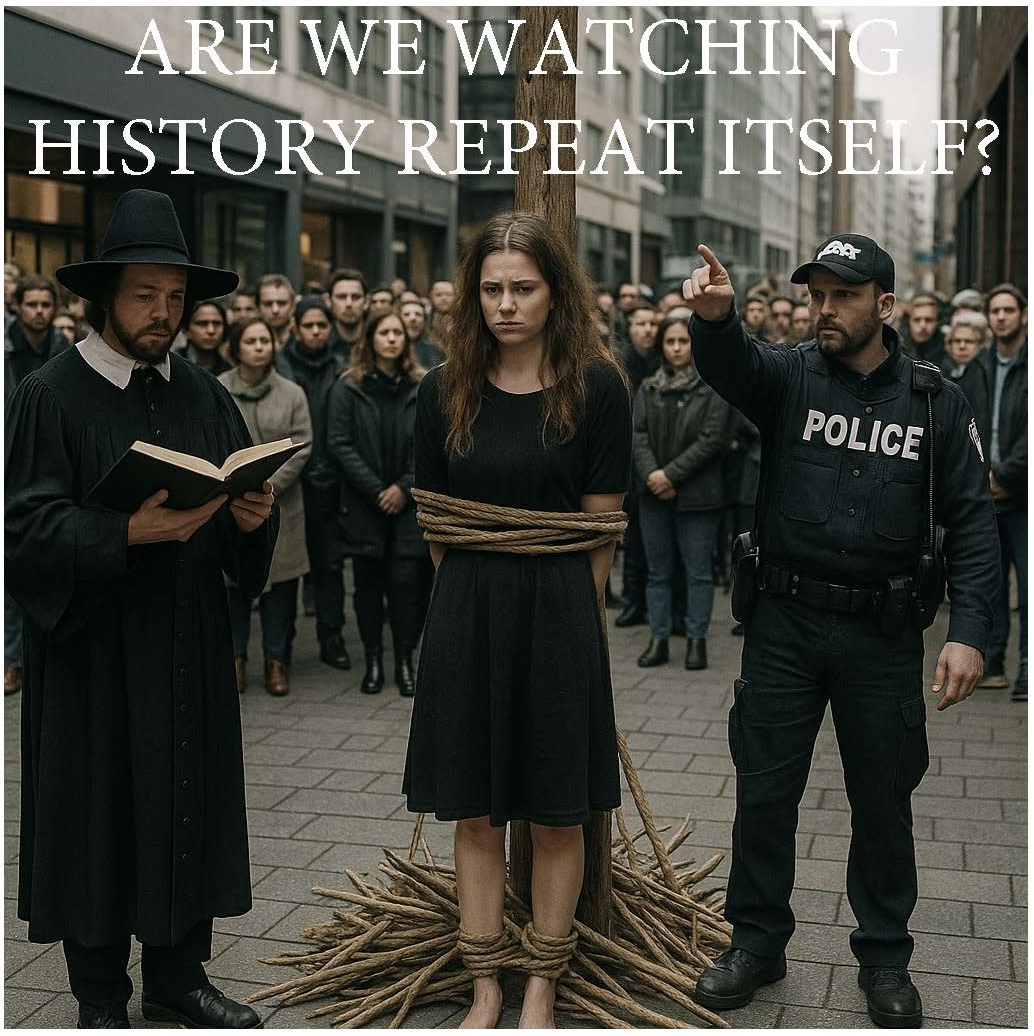
“Every age has its witch hunts—we simply change the names.” — unknown
I found myself sitting in silence today, turning over a phrase that has been echoing through the American political landscape: “the enemy within.” It is a chilling expression—one that carries the weight of centuries.
Historically, the idea of an internal enemy has been used to justify persecution, division, and state-sanctioned fear.
We have seen this in totalitarian leaders who have long framed their own citizens as threats in order to solidify control, such as:
Stalin who used the term while hunting “counter-revolutionaries,”
Lenin invoked it to justify purges against dissenters,
Mussolini wielded it against political opponents,
Hitler used it against Jews, Roma, LGBTQ+ communities, and countless others,
More recently, Vladimir Putin has used similar rhetoric to erode civil liberties (Snyder, 2017).
Are we now hearing and seeing it from our very own Commander-in-Chief?
Hearing such language from any person in political power—even in a modern democracy—carries historical resonance.
It stirs worry not merely because of what is said, but because of what has followed such phrases in the past.
Words become seeds, and history shows us what grows from them when left unchecked.
As someone who studies the long arc of witchcraft history—from ancient civilizations to the great European Trials—this phrase, “the enemy within,” hits uncomfortably close.
The witch hunts themselves were born from that very idea: the belief that danger lurked not across borders but next door, or even within one’s own household.
During the height of the European trials between the 15th and 17th centuries, tens of thousands were accused, tortured, and executed because authorities insisted that invisible threats were hidden among ordinary people (Levack, 2016).
It is impossible to forget what such rhetoric has done before. And yet I see modern echoes forming.
A Growing Divide: When Fear Becomes a Tool
America today feels increasingly divided—not just politically, but socially, culturally, spiritually.
We are witnessing leaders and influential voices pushing the narrative that certain groups of people are dangerous or “un-American” simply for holding different beliefs, identities, or ways of life.
This is not new, but the intensity has sharpened. Language that isolates, labels, or dehumanizes has historically preceded persecution (Haidt, 2022).
When I hear calls for a single “true” religion—specifically a Christian nationalist interpretation—to be elevated above all others, I cannot help but think of the long history of forced conversions, religious suppression, and inquisitions.
The ancient and medieval worlds were shaped by cultural diversity and polytheistic traditions, from the temples of Egypt to the shrines of Greece and the sacred groves of the Celts.
Each belief system contributed to the complex tapestry of what later generations would call “witchcraft.” And yet, time and again, authoritarian powers tried to erase older traditions by branding them dangerous, heretical, or demonic.
We have traveled this road before.
The Seeds of a Modern Witch Hunt
It weighs heavily on me to see hatred stirred against communities already marginalized—LGBTQ+ individuals, Pagans, witches, healers, seers, Democrats, people of color, immigrants, neurodivergent individuals, disabled people, religious minorities, and anyone who refuses to be forced into a narrow, rigid mold of what society “should” be.
Demonization of “the Other” is one of the oldest tools of oppression. The same tactics that fueled the witch hunts—fearmongering, moral panic, and claims of divine mandate—have resurfaced time and again throughout history (Barstow, 1994).
To see it growing again in modern America is deeply unsettling.
I used to align myself strongly with one political party. Over the years, I found myself in the middle, agreeing with some ideas from both sides. But as rhetoric grows more extreme—more authoritarian—my heart recoils.
I hear speeches filled not with unity or compassion but with veiled calls for division: hate those who differ from you, fear those who do not conform, reject those whose lives fall outside one religious interpretation.
This is the soil from which witch hunts grow.
Faith, Interpretation, and the Misuse of Scripture
I have many loved ones in the LGBTQ+ community. I cherish them because the divine—however one understands the divine—created them as they are.
My own spiritual journey does not include the Christian Bible as literal truth.
Historically, the text was written decades to centuries after Jesus’s lifetime, then translated and edited across languages and regimes, including by King James I, whose 1611 translation reflected his political fears, including his obsession with witchcraft (Sharpe, 1996).
Yet even within the Christian scriptures, one commandment stands out: “Love thy neighbor as thyself.”
There is no footnote excluding those with different beliefs, identities, or paths.
So when I hear people weaponize scripture to justify hatred, I see something else: self-hatred projected outward.
The true “enemy within” may not be a political opponent or a marginalized group, but the unresolved fear and insecurity a person carries inside themselves.
Have We Learned Nothing?
History has shown us the cost of “othering” our neighbors:
The European witch trials.
The crusades.
The Inquisition.
Anti-Jewish pogroms.
Colonial religious persecutions.
Anti-LGBTQ+ legislation and purges.
McCarthyism and its hunt for “subversives.”
Each began with leaders claiming that danger lurked from within.
Each was justified by fear, sanctified by rhetoric, and fueled by public anxiety.
We know the consequences. We have lived them before.
And yet here we are, watching the same patterns emerge.
Closing Reflection
I write about ancient beliefs and magical traditions because they reveal who we once were—and who we could still be. But today, I felt compelled to speak from the heart before returning to the timeline of history. Because history is happening now, and the lessons of witchcraft’s past are not abstract: they are warnings carved into time.
What frightens me most is not any one political leader.
It is the rising tide of hatred cloaked as righteousness.
Or the willingness to demonize neighbors.
Maybe it is the ease with which “the enemy within” becomes an excuse for persecution.
But I believe, still, in compassion. I believe in diverse spirits, diverse paths, diverse loves. And I believe that those who shout the loudest about hatred have not yet confronted their own deepest shadows, their own demons.
Perhaps the true “enemy within” is not who they think it is.
References:
Barstow, A. L. (1994). Witchcraze: A new history of the European witch hunts. HarperCollins.
Haidt, J. (2022). The righteous mind: Why good people are divided by politics and religion. Vintage.
Levack, B. P. (2016). The witch-hunt in early modern Europe (4th ed.). Routledge.
Sharpe, J. (1996). Instruments of darkness: Witchcraft in early modern England. University of Pennsylvania Press.
Snyder, T. (2017). On tyranny: Twenty lessons from the twentieth century. Tim Duggan Books.