


Whispers of the Flame: Magic and Witchery in Ancient Rome – Part III
🌒 Opening Verse by Sandy W.
In bronze and bone the whispers bind,
The curse is cast, the vow entwined.
Beneath the moon, by ash and ink,
The fates converge, the spirits think.
🕯️ Between Faith and Fear
Magic in Ancient Rome existed in a twilight realm—between the accepted religious rites and the forbidden arts of sorcery. To a Roman citizen, the difference between a priest and a magician was not what they did, but why and for whom. The priest acted for the good of the state; the magician, for personal desire or revenge. Yet both called upon unseen powers and shaped fate through ritual and words.
Rome’s enchantments were woven from the threads of many cultures—Greek, Etruscan, Egyptian, and local Italic beliefs. This blending created a rich tapestry of magical practice that permeated every aspect of life, from love and health to justice and revenge.
🔮 Tools of the Ancient Spellcaster
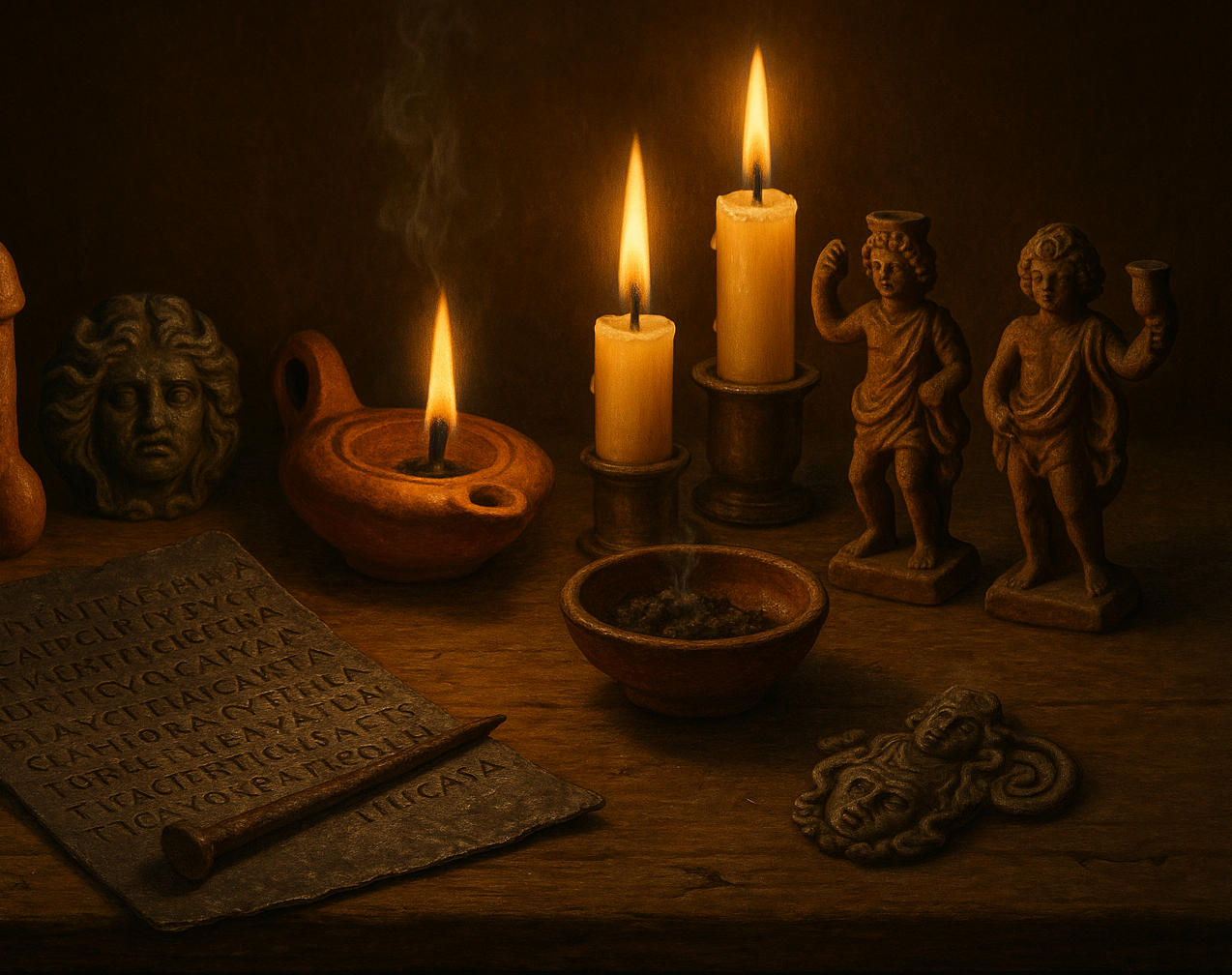
Roman magic was tactile. Spells weren’t just spoken—they were crafted. Practitioners used objects infused with intention and symbol.
- Amulets and Talismans: Crafted from bronze, bone, or carved gemstones, these items were worn to attract good luck or ward off bad fortune. The bulla, a small pendant given to Roman children, protected them from the evil eye—a superstition so strong it crossed all social classes and religions.
- The Fascinum: A phallic charm symbolizing the creative power of the god Fascinus, used to protect against envy and harm. Even soldiers carried them on their armor or horse harnesses.
- Herbs and Oils: Rue, garlic, myrrh, and frankincense were among the many materials burned in ritual fires to evoke protection or clarity.
- Tablets and Scrolls: Spells were inscribed onto thin sheets of lead or papyrus, often folded and pierced with nails to “bind” the will of another.
These spell objects blurred the line between religion and witchcraft. What was piety in one hand could be considered heresy in another. It was all a matter of who sanctioned the magic—and who feared its result.
🕳️ Curses and Defixiones
Perhaps the most fascinating—and chilling—of Roman magical practices were the defixiones, or curse tablets. These thin lead sheets were inscribed with names, commands, and pleas to underworld deities. The petitioner might ask the spirits to silence a rival in court, destroy an enemy’s love life, or cause insomnia, madness, or failure.
Curses were often buried in tombs, wells, or sanctuaries—places believed to be near the underworld. Some called upon gods like Hecate, Mercury, or Proserpina, while others invoked nameless spirits of the dead. Many started with the phrase: “I bind you…”—a straightforward and chilling plea to unseen powers.
Yet not all curse tablets aimed to cause harm. Some were desperate pleas for justice, for the return of stolen property or the punishment of trickery. These reveal the human side of Roman witchcraft: the desire for fairness within a system of hierarchy and fate.
🌿 Love and Protection
Not all Roman spells were dark. Many were gentle acts of devotion—love charms, fertility prayers, and protective invocations. Women often turned to the goddess Venus for matters of the heart, crafting potions of rose petals, honey, and wine. Others invoked Fortuna, the goddess of chance, to tilt destiny in their favor.
Protective amulets were common among soldiers and travelers. Some carried tiny figurines of Hercules for strength, while others carried a charm of Isis for safe passage. Even emperors employed astrologers and magicians, despite officially condemning them. The contradiction was simple: everyone, no matter how powerful, longed to influence the unseen.
🪶 Echoes in Modern Practice
Today, we still see echoes of Rome’s enchanting art. The wearing of charms, the writing of names on paper during spells, the use of herbs and oils—all trace back to ancient hands shaping intention through tangible means.
When a modern practitioner burns incense for clarity, ties a ribbon to manifest a wish, or writes a name to release pain, they follow the same path as Rome’s magicians and witches. The line between past and present blurs—one flame, passed down through centuries of belief and longing.
🌕 Closing Reflection
Magic, to the Romans, was not evil—it was unavoidable. Where the gods dictated destiny, humans tried to push back. Every curse, every blessing, every secret spell was an act of rebellion and devotion, all rooted in the same truth:
that within each of us lies the desire to shape what we cannot see.
“As above, so below; as within, so without.”
📚 References
- Faraone, C. A. (1999). Ancient Greek Love Magic. Harvard University Press.
- Graf, F. (1997). Magic in the Ancient World. Harvard University Press.
- Ogden, D. (2009). Magic, Witchcraft, and Ghosts in the Greek and Roman Worlds: A Sourcebook. Oxford University Press.
- Phillips, C. R. (2001). Defixiones: Curse Tablets and Binding Spells of the Ancient World. Oxford University Press.
- Versnel, H. S. (1991). Beyond Cursing: The Appeal to Justice in Judicial Prayers. In Magika Hiera: Ancient Greek Magic and Religion (pp. 60–106). Oxford University Press.
✨ Suggested Readings
- Hutton, R. (2017). The Witch: A History of Fear, from Ancient Times to the Present. Yale University Press.
- Green, C. (2018). Roman Religion and the Cult of Diana at Aricia. Cambridge University Press.
- Wilburn, A. T. (2012). Materia Magica: The Archaeology of Magic in Roman Egypt, Cyprus, and Spain. University of Michigan Press.
