


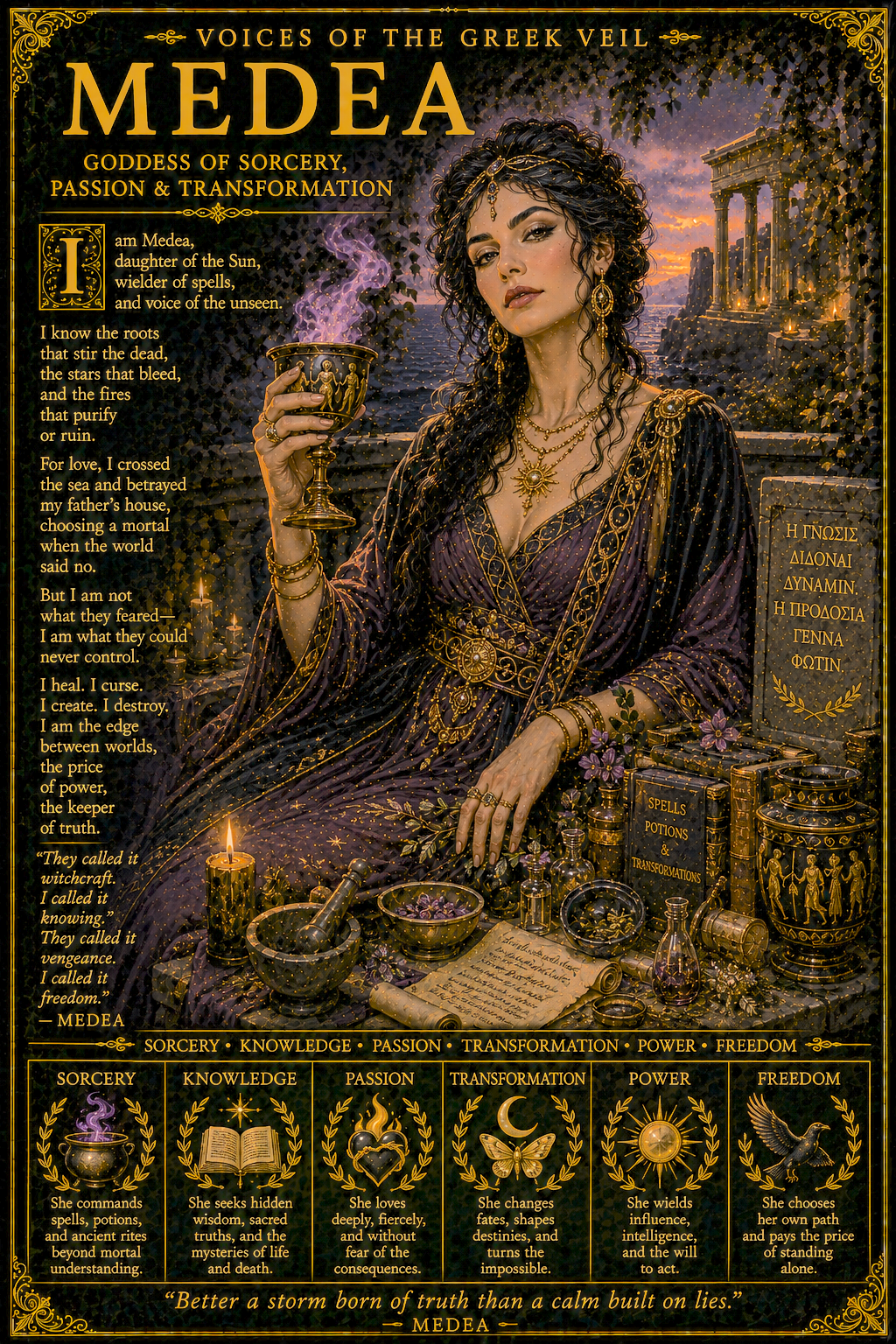
🩸 Mortal Sorceress and Priestess–Medea: Blood, Betrayal, and the Witch’s Rage
🌙 Verse by Sandy W.
By night she danced where wild roots grew,
With flame in heart and fingers blue.
She loved, she bled, she broke the chain—
And cast her spell through wrath and pain.
🧪 Sorceress of Fire and Fury
Few names in the ancient world carry as much power, passion, and peril as the mortal sorceress and priestess, Medea. She is remembered as a priestess, a poisoner, a princess, a mother, a murderer, and a witch.
Her story is one of devotion turned vengeance, and her legacy is one of the most complex in myth and magic.
Was Medea a monster? Or was she a woman undone by betrayal, using the only weapons she was allowed?
Beneath the dramatics of Euripides and Roman poets lies the truth: Medea was a daughter of Hekate—and one of the most powerful magical women in ancient lore.
🐍 Daughter of Colchis and Priestess of Hekate
Medea was the daughter of King Aeëtes of Colchis and niece of Circe, both known for their magical bloodlines.
She was raised as a priestess of Hekate, and in some myths, taught directly by the goddess herself. Her skills included:
- Pharmakeia: the use of herbs and potions for healing or harm
- Necromancy and purification rites
- Protective magic, especially involving fire and oils
- Transformative magic—changing the state of the body or spirit
Her homeland, Colchis, located at the edge of the known world, was seen by the Greeks as a land of deep magic, mystery, and foreign power.
🛡️ The Argonauts and the Spell of Love
Medea’s most well-known tale begins with the arrival of Jason and the Argonauts, who sought the Golden Fleece.
Aphrodite compelled her to fall in love with Jason, but it was Medea’s magic—not Jason’s courage—that made the quest a success.
She:
- Gave Jason a potion to survive the fire-breathing bulls
- Helped him defeat warrior-born from dragon’s teeth
- Guided him past the sleepless serpent guarding the fleece
- Murdered her own brother Apsyrtus to delay her father’s pursuit
In every version, she gives everything—love, loyalty, country, and blood—to aid the man she believes will honor her.
He does not.
⚔️ Betrayal and the Birth of the Curse
Jason and Medea flee to Corinth, where they are accepted into high society and have children. But Jason, ever the hero of entitlement, abandons Medea to marry the king’s daughter, Glauce, in a bid for political power.
Medea is exiled. Her children threatened. Her heart, broken.
And so, she remembers her power.
She gifts Glauce a robe and crown anointed with fire-poisoned oils—burning her alive.
In some versions, she murders her own children to punish Jason fully.
In others, they are killed by an angry mob, or taken by the gods. The myth varies, but the spell remains: a woman, cornered, becomes wrath incarnate.
🔮 Medea as Witch Archetype
To the Greeks, Medea became the symbol of the foreign sorceress—dangerous, other, unknowable. But in her story we find enduring themes:
- The cost of feminine power
- The weaponization of magic by the betrayed
- The injustice of being punished for one’s own survival
- The sacred fury of a witch who has lost everything
She is both a victim and a villain; as well as a healer and a hexer.
Modern witches reclaim Medea not as an evil figure, but as a warning and a wisdom: Never give your power to one who does not honor it.
🌒 Closing Reflection
The mortal sorceress and priestess Medea’s voice is a bitter wind that howls through time. She is not a goddess or divine. Medea is mortal—and that is what makes her terrifying.
She reminds us that magic does not always heal. Sometimes, it burns.
📚 References
Euripides. (2006). Medea (J. Davie, Trans.). Penguin Classics.
Graf, F. (1997). Magic in the ancient world (F. Philip, Trans.). Harvard University Press.
Ogden, D. (2009). Magic, witchcraft, and ghosts in the Greek and Roman worlds: A sourcebook (2nd ed.). Oxford University Press.
Johnston, S. I. (2008). Ancient Greek divination. Wiley-Blackwell.
Clauss, J. J. (1993). The best of the Argonauts: The redefinition of the epic hero in book 1 of Apollonius’s Argonautica. University of California Press.
🔍 Suggested Readings
- Illes, J. (2009). The Element Encyclopedia of Witchcraft. HarperElement.
- D’Este, S. (2008). Hekate: Keys to the Crossroads. Avalonia.
- Morrison, S. (2019). Witches: The Transformative Power of Women Working Together. Octopus Books.
- Women and Myth Blog: Reclaiming Medea: Feminism and the Witch Archetype
- Tripp, E. (2010). The Meridian Handbook of Classical Mythology. Penguin Reference.
- Temple of Hekate – Devotional practices of Medea’s lineage: https://hekatecovenant.com