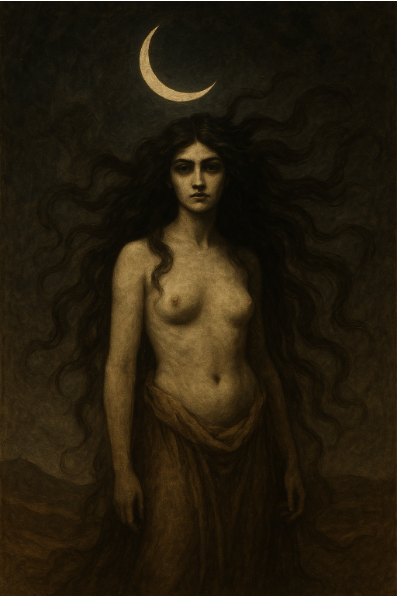
A Mesopotamia: Voices of the Veil Series Post
🕯️ Opening Verse by Sandy W.
“Born of dust and breath, she rose unclaimed—
Neither rib nor bound by name.
In fierce silence, she spread her wings.
A whisper dark, where freedom sings.”
The Ancient Breath—Lilitu of the Mesopotamian Night
Long before Lilith became the whispered name of fear and fascination, she dwelled in the winds of ancient Mesopotamia.
The Sumerians and Akkadians spoke of Lilitu, Lilu, and Ardat Lili—spirits of the night whose presence was both alluring and dangerous.
These entities roamed the dark edges of deserts and dreams, carried on storms that were said to breathe illness or desire into the world.
In early Sumerian texts, the word lil meant “air” or “spirit.”
The Lilitu were not inherently evil—they embodied the unseen forces of nature, the sensual, unpredictable powers that could both nurture and destroy.
Over centuries, these winds were personified into a single feminine figure—a shadowed goddess whose freedom terrified those who sought order.
The Rebellion in Eden—The Hebrew Transformation
When her story was absorbed into Hebrew myth, Lilith became the defiant first wife of Adam.
According to the Alphabet of Ben Sira, she was created from the same earth as Adam, not from his rib.
She refused to lie beneath him, declaring, “We are equal, for we are both made from the dust.”
When Adam sought to dominate her, Lilith spoke the secret name of God and flew from Eden, crossing the threshold from mortal to myth.
For her refusal to submit, she was cast as the mother of demons, blamed for stillbirths, lust, and nocturnal temptations.
Yet beneath these accusations lies a deeper truth: Lilith’s rebellion was not one of malice—it was of autonomy.
She became the embodiment of the forbidden feminine, the woman who dared to choose herself.
From Demon to Dark Goddess—The Medieval Evolution
In medieval mysticism and Kabbalistic texts like the Zohar, Lilith’s image deepened into shadow.
She was portrayed as the consort of Samael—the fallen angel—and ruler of the succubi.
Religious fear transformed her into the eternal warning against women who stepped beyond patriarchal bounds.
But witches and mystics whispered another truth.
Within Lilith’s darkness lay ancient wisdom—power untempered by submission, passion unrestrained by shame.
She was invoked by some as a guardian of the night, protectress of women, and keeper of the mysteries of desire and sovereignty.
The Reclamation—Feminism, Witchcraft, and Modern Power
In modern witchcraft and feminist spirituality, Lilith has been reborn once more—not as a demon, but as a goddess of freedom and truth.
To many witches, she represents the Dark Moon, the hidden self that refuses to be silenced.
She teaches that power does not always come cloaked in light; sometimes, it comes from embracing the shadows we were taught to fear.
Lilith’s myth has become a mirror for the collective awakening of the feminine.
She invites us to reclaim what has been called sinful: our voice, our body, our will.
In her name, many find the courage to walk the solitary path—to live unapologetically as the author of their own fate.
Reflection: What Lilith Teaches Us Today
Lilith is the breath of rebellion in every woman told to obey.
She is the whisper in every witch who dares to practice in her truth.
Her story reminds us that the shadow is not our enemy—it is our teacher.
When we call upon Lilith, we are not calling the destroyer but the liberator—the one who chose exile over silence. And perhaps, in that eternal choice, she was never cast out of Eden at all.
Perhaps she simply chose to build her own.
References (APA 7th Edition)
Ackerman, S. (1992). Under every green tree: Popular religion in sixth-century Judah. Scholars Press.
Hurwitz, S. (1992). Lilith: The First Eve. Northwestern University Press.
Patai, R. (1990). The Hebrew goddess (3rd ed.). Wayne State University Press.
Rosenberg, D., & Bloom, D. (Eds.). (1990). The book of Lilith. Harper & Row.
Tigay, J. H. (1986). You shall have no other gods: Israelite religion in the light of Hebrew inscriptions. Scholars Press.
Suggested Readings
- Barbara Black Koltuv, The Book of Lilith
- Monica Sjöö & Barbara Mor, The Great Cosmic Mother
- D. M. Murdock, Did Moses Exist? The Myth of the Israelite Lawgiver
- Joseph Campbell, The Power of Myth

