


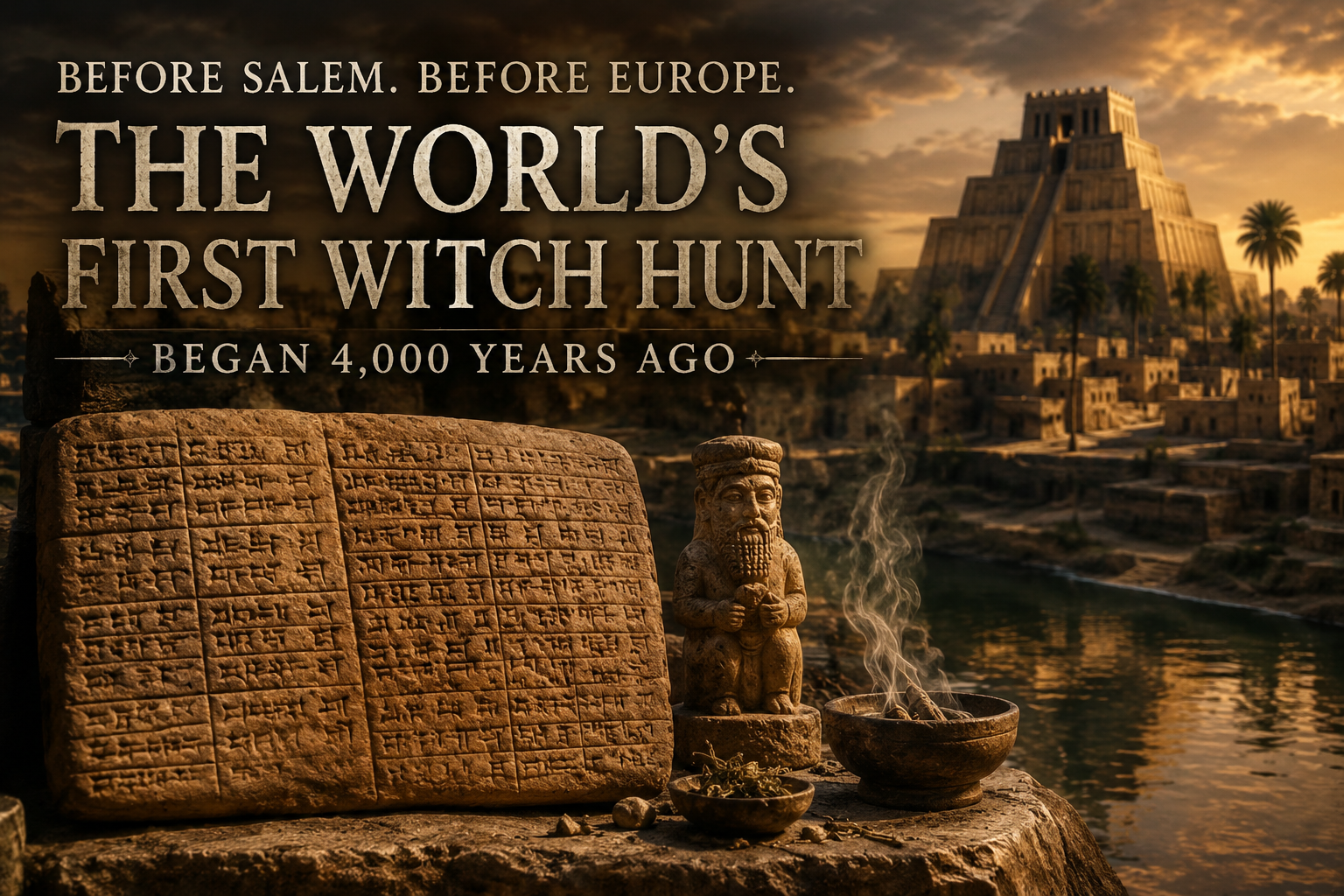
“Long before black hats, broomsticks, and the infamous witch trials of Europe, another civilization feared the unseen power of magic. Their story is where the history of witch persecution truly begins.”
When most people hear the words witch hunt, their minds immediately drift to Salem, the fires of medieval Europe, or the infamous trials that scarred Scotland and Germany.
Popular culture has convinced us that the persecution of witches began during the Middle Ages.
The truth is far older.
Thousands of years before Christianity existed, before the Roman Empire rose to power, and even before the first castles were built in Europe, the people of ancient Mesopotamia already believed that unseen forces could bring illness, misfortune, infertility, crop failure, and death.
Those forces were often blamed on individuals believed to possess dangerous magical abilities.
This is where our story begins.
A World Where Magic Was Real
To the ancient Sumerians, Akkadians, Babylonians, and Assyrians, magic was not fantasy—it was part of everyday life.
Just as medicine was real…
Just as prayer was real…
So too was witchcraft.
People believed there were two forms of supernatural power. One could heal, bless, and protect.
The other could curse, poison, and destroy. While priests and temple healers called upon the gods to restore balance, others were feared for secretly using harmful magic against their neighbors.
Unlike modern ideas of witches, these accusations had nothing to do with flying through the night or making pacts with the Devil. Those beliefs would not emerge for thousands of years.
Instead, witchcraft was believed to be an invisible crime.
A sick child.
A failed harvest.
An unexplained death.
A business ruined.
Someone, somewhere, must have caused it.
The Earliest Witch Persecution
One of the fascinating realities of history is that we do not know the name of the very first person accused of witchcraft.
The earliest surviving records simply did not preserve the identities of the accused.
What they did preserve were detailed rituals written on clay tablets describing how to identify, expose, and protect oneself from those believed to be practicing harmful magic.
Some of these texts date back nearly four thousand years and contain elaborate ceremonies meant to break curses, destroy magical attacks, and call upon the gods for protection.
They describe witches not as fantasy figures, but as real enemies capable of causing disease, nightmares, infertility, or financial ruin through supernatural means.
These tablets reveal something deeply human:
When people could not explain tragedy, they searched for someone to blame.
Fear Creates an Enemy
Imagine living in a world without modern medicine.
Your child suddenly becomes ill; your crops fail; your livestock dies.
A healthy neighbor collapses without warning.
There are no microscopes.
No understanding of bacteria, no weather forecasts, and no scientific explanations.
Fear demands an answer.
For many ancient people, that answer became witchcraft.
It was easier to believe that someone had secretly cursed you than to accept that disaster could simply happen.
That fear became the foundation upon which later witch hunts would be built.
From Ancient Mesopotamia to Medieval Europe
Although separated by thousands of years, there is a striking similarity between the first accusations recorded in Mesopotamia and the witch trials that would later consume Europe.
Both were driven by uncertainty; both looked for invisible enemies; and both transformed ordinary people into objects of suspicion.
The difference is that the Mesopotamians generally sought to remove the effects of witchcraft through ritual purification, prayers, and protective magic performed by trained exorcists and priests.
Large-scale judicial executions for witchcraft would not become common until many centuries later.
The great European witch hunts did not invent the fear of witches.
They inherited it.
Why This Story Matters
History often begins where the surviving evidence begins—not necessarily where the events themselves began.
The first accused witch has been lost to time.
Her name, if it was recorded at all, disappeared thousands of years ago.
Yet the fear that created her accusation survived.
It crossed civilizations, religions, and continents.
And eventually, it reached medieval Europe, where fear, politics, religion, and social unrest combined to create one of history’s darkest chapters.
When we remember the victims of the witch trials, we should also remember that their story did not begin in Salem or Scotland.
Its roots reach back to the cradle of civilization itself.
And perhaps the greatest lesson history offers is this:
Herbs, rituals, or whispered incantations have never been the most dangerous magic — it has always been fear.
Further Reading
- Daniel Schwemer, The Anti-Witchcraft Ritual Maqlû: The Cuneiform Sources of a Magic Ceremony from Ancient Mesopotamia (Harrassowitz Verlag, 2017). https://openlibrary.org/books/OL44447155M/The_anti-witchcraft_ritual_Maql%C3%BB
- Corpus of Mesopotamian Anti-Witchcraft Rituals Online (CMAwRo). https://www.phil.uni-wuerzburg.de/cmawro/
- British Museum, Maqlû (“Burning”) anti-witchcraft tablets from the Library of Ashurbanipal. https://www.bmimages.com/preview.asp?image=00109500001
- Encyclopedia of Crime, “Witchcraft.” https://sk.sagepub.com/ency/edvol/crimepunishment/chpt/witchcraft#_